

Modernizing legacy architectures, dynamic internal controls, and real-time risk management across enterprise environments.
Artificial intelligence enhances SOX compliance by automating data monitoring, strengthening dynamic internal controls, and streamlining audit evidence gathering. By modernizing legacy accounting architectures, AI shifts financial governance from manual sampling to continuous or near real-time transaction monitoring. Integrating advanced analytics and predictive intelligence allows enterprise organizations to maintain regulatory integrity and reduce manual audit workloads.
Organizations today face growing pressure to meet stringent regulatory standards in an ever-evolving business landscape. The Sarbanes-Oxley Act (SOX) is one such regulation aimed at ensuring the accuracy and integrity of financial reporting. As companies strive for compliance, many turn to artificial intelligence (AI) to streamline their processes and improve accuracy. This article explores how AI strengthens SOX compliance by streamlining processes, enhancing risk management, and improving documentation across modern enterprises.
Understanding SOX Compliance and Core Regulatory Requirements
The Sarbanes-Oxley Act, enacted in 2002 in response to major financial scandals, established a framework for corporate governance and accountability. It mandates strict reforms to enhance transparency in financial reporting and protect investors from fraudulent activities. Key provisions include:
- Section 302: Mandates corporate responsibility for financial reports by requiring senior executives to certify the accuracy of financial statements.
- Section 404: Mandates an annual assessment of internal controls over financial reporting (ICFR).
- Section 409: Requires timely, real-time disclosures of material changes in financial conditions.
To meet these requirements, organizations must adopt robust systems for monitoring, reporting, and validating financial data. According to KPMG’s annual SOX survey, maintaining compliance demands an average of $2.3 million and over 15,000 person-hours per organization each year, making SOX compliance both a complex and resource-intensive endeavor for management teams.
How Artificial Intelligence Reshapes SOX Compliance
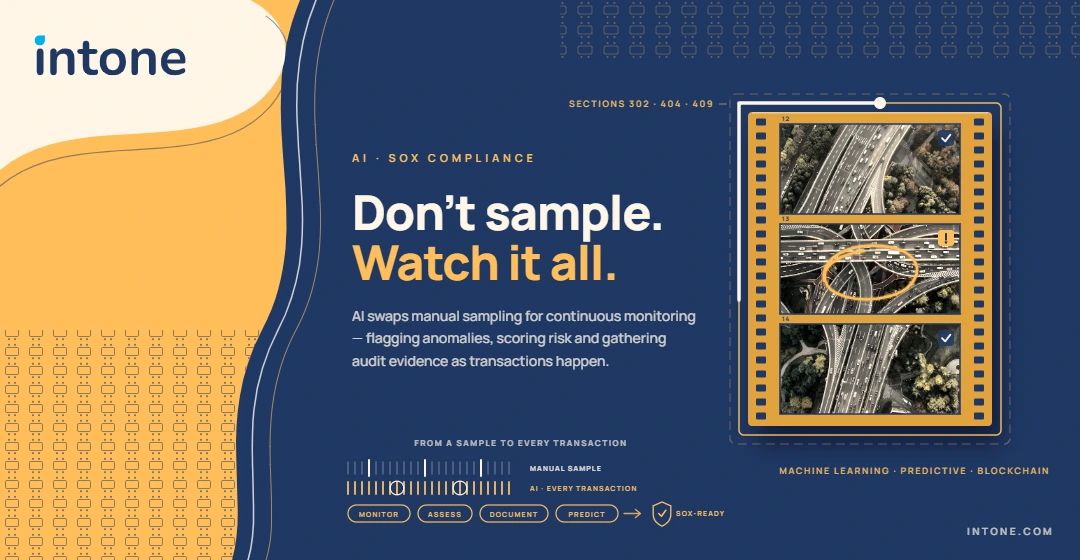
Artificial intelligence has emerged as a transformative tool in financial oversight, and its application in SOX compliance is no exception. By modernizing legacy accounting architectures, AI empowers compliance teams to shift away from manual sampling toward comprehensive continuous coverage through comprehensive GRC and advisory solutions.
Automated Data Monitoring and Modern Data Analytics
AI, powered by machine learning, enables real-time analysis of vast financial datasets, identifying irregularities instantly. With the integration of advanced data analytics services, organizations can leverage sophisticated algorithms to process and interpret complex transactions effectively. Continuous transaction monitoring allows AI to swiftly detect anomalies that could indicate fraud or non-compliance. By automating data analysis through dedicated data analytics workflows, organizations significantly reduce manual audit workloads while raising overall accuracy.
Enhanced Risk Assessment and Dynamic Internal Controls
AI-driven tools evaluate risks associated with financial reporting far more effectively than traditional static methods. By leveraging historical records and predictive intelligence via AI enablement solutions, these systems evaluate non-compliance probabilities based on past incidents, operational changes, and market shifts, resolving potential issues before escalation. Furthermore, AI strengthens internal controls through intelligent monitoring that tracks user behavior and flags unauthorized access attempts to sensitive financial data.
Streamlined Documentation, Reporting, and Audit Evidence Gathering
Compliance with SOX necessitates meticulous documentation of financial processes and internal controls. AI automates record-keeping while rapidly generating precise compliance reports to keep pace with dynamic regulatory obligations. In audit scenarios, AI collates relevant documentation automatically for auditors and analyzes past audit findings to continuously improve corporate compliance frameworks.
The Future Landscape of AI-Driven Regulatory Solutions
As technology continues to advance, the role of AI in financial oversight will expand exponentially. Future innovations in predictive intelligence combined with distributed ledgers like blockchain will help strengthen financial reporting integrity, especially when backed by a robust cloud data management strategy.
Conclusion
AI is transforming regulatory oversight by providing tools that simplify requirements and boost operational efficiency. From automated data monitoring to strengthened internal controls, embracing AI positions organizations for greater transparency, speed, and long-term success in meeting complex financial governance standards.
FAQ’s
AI powered by machine learning enables real-time analysis of vast financial datasets, identifying irregularities instantly. By automating data analysis through continuous transaction monitoring, AI detects anomalies indicating fraud or non-compliance, significantly reducing manual audit workloads while raising overall accuracy.
AI-driven tools leverage historical records and predictive analytics to evaluate non-compliance probabilities based on past incidents, operational changes, and market shifts. Additionally, AI tracks user behavior and flags unauthorized access attempts to sensitive financial data in real time.
AI automates record-keeping, rapidly generates precise compliance reports to meet dynamic regulatory obligations, collates relevant documentation automatically for auditors during audit scenarios, and analyzes past audit findings to continuously improve corporate compliance frameworks.
Legacy accounting architectures rely heavily on manual sampling and static methods. Modernizing these architectures with AI empowers compliance teams to shift toward comprehensive continuous coverage, eliminating operational friction and audit blind spots.
The future role of AI in financial oversight will expand through innovations in predictive intelligence combined with distributed ledgers like blockchain, further guaranteeing the absolute integrity and transparency of enterprise financial reporting.
Is manual sample testing and legacy accounting friction creating audit blind spots in your SOX compliance process?
Intone’s AI-powered compliance automation transforms SOX oversight from periodic manual sampling into continuous transaction monitoring, dynamically capturing audit evidence and flagging financial anomalies before they escalate.
Automate your SOX compliance and eliminate manual audit friction today.