

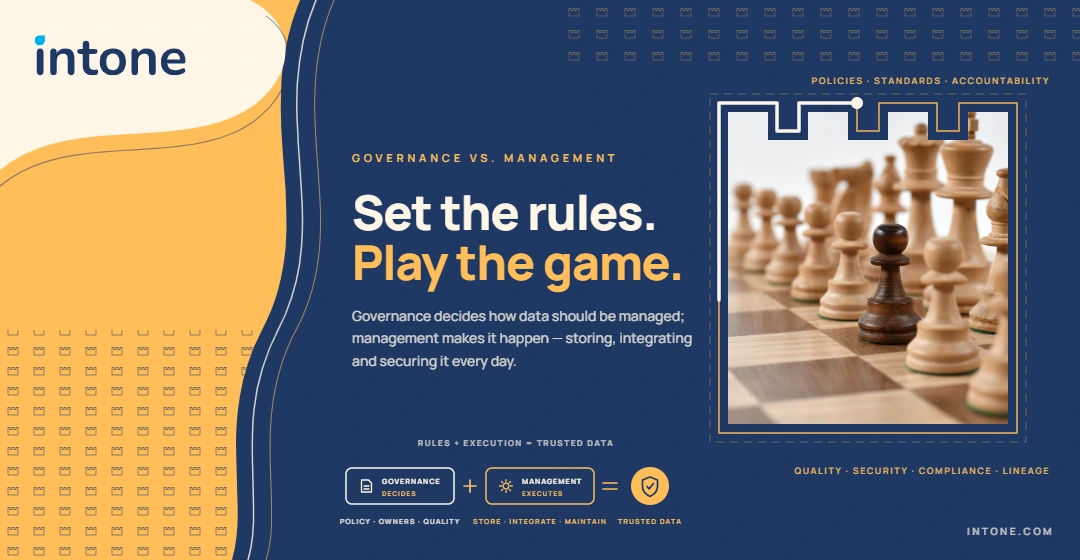
Data governance establishes policies, rules, standards, and responsibilities for how an organization manages its data, while data management focuses on implementing those policies through technologies, processes, and procedures. In simple terms, governance defines how data should be managed, while management puts those rules into practice through activities such as data integration, storage, processing, quality management, security, and analytics. Understanding data governance vs data management helps organizations improve data quality, meet compliance requirements, support business objectives, and gain practical insights for better decision-making.
Data Governance vs Data Management
Data governance and data management work together, but they serve different purposes. Governance establishes the rules, policies, and responsibilities for managing data, while data management focuses on implementing processes and technologies to collect, organize, store, integrate, and maintain it.
| Aspect | Data Governance | Data Management |
| Purpose | Establishes policies, standards, and accountability for data | Collects, organizes, stores, integrates, and maintains data |
| Ownership | Typically led by data governance teams, data owners, and business stakeholders | Typically managed by IT, data management, and engineering teams |
| Focus | Data quality, security, compliance, policies, and accountability | Data storage, integration, accessibility, processing, and lifecycle management |
| Examples | Defining data standards, access policies, retention rules, and compliance requirements | Building databases, integrating systems, maintaining data pipelines, and managing engineering data |
In simple terms: Data governance defines how data should be managed, while data management handles how data is managed in practice.
_________________________________________________________________________
What is Data Governance?
Data governance is an important component of overall data management. It is the discipline of controlling how information is created, processed, accessed, shared, protected, and maintained within an organization.
A data governance framework defines the processes and responsibilities required to maintain the quality, security, consistency, and appropriate use of information. It establishes who can access particular data assets, what actions they can perform, under which circumstances, and what procedures should be followed.
Effective governance is particularly important when organizations manage large volumes of information across multiple applications, departments, and business functions. Without clear governance, different teams may follow different processes, create inconsistencies, and increase the risk of inaccurate or unauthorized information usage.
A well-designed governance approach can also support compliance, security, accountability, and organizational transparency.
You might be interested in knowing how to build a data governance strategy.
What is Data Management?
Data management refers to the design and implementation of technologies, processes, and procedures used to manage an organization’s complete data lifecycle.
It covers activities such as data collection, data storage, integration, transformation, processing, quality management, security, analysis, and maintenance. The objective is to ensure that information remains accessible, reliable, secure, and useful for the organization.
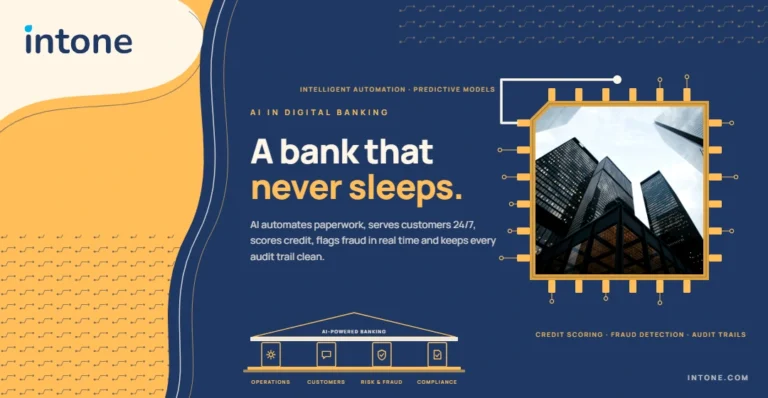
Organizations increasingly depend on data to support business operations, reporting, analytics, and strategic planning. As a result, effective data management is essential for turning raw information into useful and actionable information.
Data management can also support different business needs across industries. For example, data management service in manufacturing can help organizations accurately track and report manufacturing activities, supporting product quality, safety standards, and inventory control.
Data Governance Framework and Data Management
A data governance framework and data management work together rather than operating as completely separate disciplines.
Governance establishes the rules, policies, responsibilities, and standards that determine how information should be handled. Data management provides the technologies and operational processes needed to implement those requirements.
For example, governance may establish a policy requiring sensitive information to be restricted to authorized users. Data management processes can then implement that policy through access controls, authentication mechanisms, storage configurations, and monitoring systems.
This relationship demonstrates why both disciplines are important. Governance without implementation can remain theoretical, while management without governance can result in inconsistent processes and uncontrolled information.
Distinctions Between Data Governance and Data Management
It is critical to recognize that governance is a component of overall data management. Data governance establishes the framework, while data management puts that framework into practice.
The distinction can be understood through the following points:
- Rules vs. implementation: Data governance establishes rules, standards, and policies, while data management implements them through technologies and operational processes.
- Decision-making vs. execution: Governance determines how organizations should make decisions about information, while management handles how information is collected, stored, transformed, processed, and used.
- Business and IT involvement: Governance commonly involves business managers, data owners, IT teams, and other stakeholders, while data management involves technical roles responsible for implementing and maintaining systems.
- Policies vs. tools: Governance technologies can include data dictionaries, glossaries, catalogs, and policy frameworks. Data management tools focus more heavily on storage, processing, integration, transformation, and exploration.
- Control vs. use: Governance controls how organizations decide about using information, while management focuses on carrying out the activities required to use information effectively.
Data Quality, Security, and Compliance
One of the major objectives shared by governance and management is maintaining data quality.
Poor-quality information can lead to incorrect reports, inefficient processes, inaccurate analysis, and an unreliable foundation for a business decision. Data governance establishes standards and responsibilities for maintaining quality, while data management implements validation, cleansing, integration, and monitoring processes.
Security is another important consideration. Organizations need appropriate controls to protect sensitive information throughout their lifecycle. Governance can define security policies, while management can implement access controls, encryption, authentication, monitoring, and other technical measures.
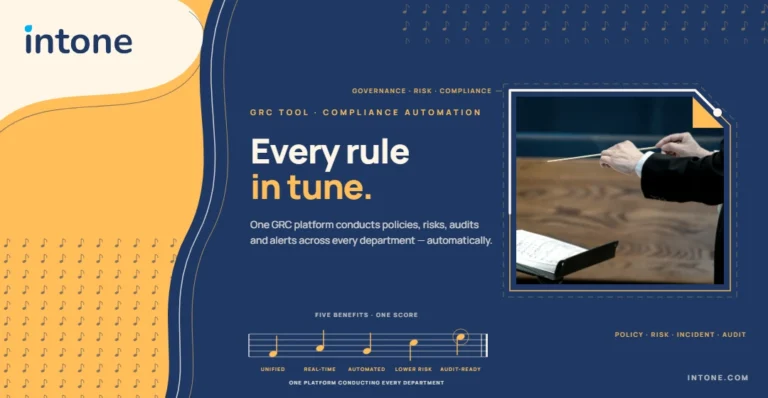
Both disciplines can also contribute to compliance. Organizations may need to demonstrate that information is handled according to internal policies, industry requirements, contractual obligations, or applicable regulations.
Effective Data Management for Business Success
Effective data management enables organizations to transform information into useful business resources.
When information is properly integrated, stored, processed, and maintained, teams can access more reliable information for reporting and analysis. This can help organizations identify trends, understand performance, and develop valuable insights.
For example, business teams may use integrated information to monitor key performance indicators, identify operational issues, or understand customer behavior. Advanced analytics and predictive analytics can further help organizations identify potential trends and support forward-looking decisions.
This makes effective data management an important contributor to business success.
Enterprise Leaders and Strategic Guide to Governance
Enterprise leaders increasingly need to understand the relationship between governance and management because data affects almost every part of an organization.
A strategic guide to data governance should consider organizational objectives, business needs, security requirements, compliance, data quality, technology, and stakeholder responsibilities.
Leaders should establish clear ownership and accountability while ensuring that governance requirements can be practically implemented through existing systems and processes.
The goal should not simply be to create more policies. Instead, organizations should develop a framework that supports business objectives while allowing employees and teams to use information efficiently and responsibly.
GRC Advisory and Modern Data Governance
Organizations dealing with complex regulatory and security requirements may also benefit from GRC advisory capabilities.
Governance, risk, and compliance activities can help organizations identify risks, establish appropriate controls, and align information management practices with organizational requirements.
As security topics and regulatory expectations continue to evolve, organizations need governance approaches that can adapt to changing requirements.
A coordinated approach to governance, risk, compliance, and management can help organizations maintain greater visibility over their data assets while reducing potential operational and regulatory risks.
Data Integration, Business Intelligence, and Practical Insights
Data integration plays an important role in connecting information from different systems.
Organizations may have information distributed across databases, applications, cloud platforms, operational systems, and business applications. Integrating these sources can create a more consistent foundation for business intelligence and analytics.
Once information is integrated and governed effectively, teams can use analytical technologies to generate practical insights.
These insights can support operational planning, strategic decisions, predictive analytics, performance monitoring, and other business activities. The combination of governance, management, and integration therefore helps organizations move from simply storing information to generating measurable business value.
Why IntoneSwift®?
Effective data management and governance are critical components of establishing IT systems that support business applications and analytical information.
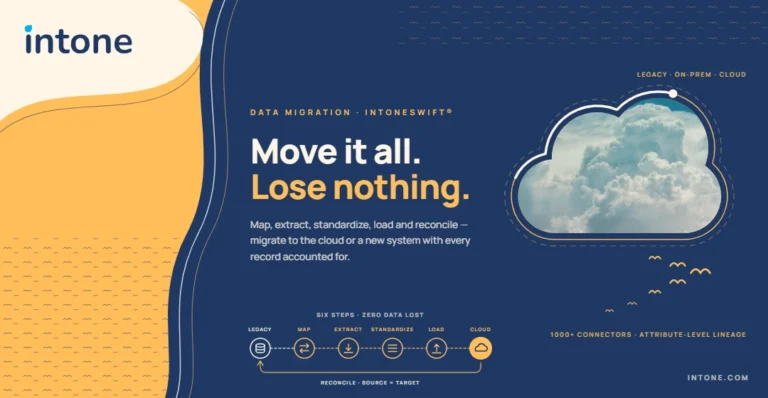
At Intone, we take a people-first approach to data management. We understand that organizations need solutions capable of supporting integration, governance, security, processing, and analytics while adapting to their specific business needs.
IntoneSwift® provides capabilities designed to help organizations manage complex information environments. It offers:
- Knowledge graph for all data integrations done
- 1000+Data, Application, and Device connectors
- A graphical no-code/low-code platform
- Distributed In-memory operations that provide 10X speed in data operations
- Attribute-level lineage capturing at every data integration map
- Data encryption at every stage
- Centralized password and connection management
- Real-time, streaming, and batch processing of data
- Support for unlimited heterogeneous data source combinations
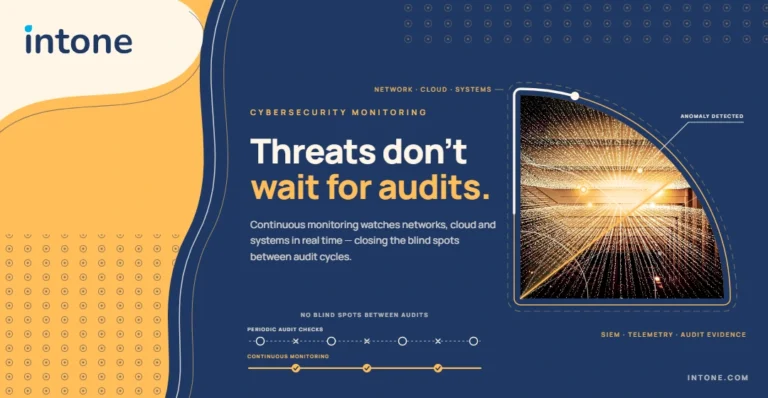
- Monitoring capabilities that provide real-time updates
These capabilities can help organizations connect information sources, improve visibility, support governance requirements, and establish more effective data management processes.
Conclusion
Understanding data governance vs data management is essential for organizations seeking to build a reliable and responsible information environment.
Data governance establishes policies, standards, responsibilities, and controls that determine how information should be managed. Data management implements these requirements through technologies, processes, integration, storage, processing, security, and analytics.
When these disciplines work together, organizations can improve data quality, support compliance, protect data assets, meet business objectives, and generate valuable insights.
For enterprise leaders, the objective should be to create a practical governance and management strategy that supports both organizational control and business success.
Data Governance decides the rules; Data Management executes them.
Contact us To learn more about how we can help you!
FAQ’s
Data governance establishes policies, standards, responsibilities, and rules for how an organization should use and manage its data. Data management focuses on implementing those policies through processes and technologies such as data integration, data storage, processing, security, and analytics. In simple terms, governance defines the rules, while management puts those rules into practice.
Data governance helps businesses maintain data quality, security, consistency, and accountability. It establishes clear responsibilities for managing data assets and can help organizations meet compliance requirements. A strong data governance framework also enables businesses to use reliable information for better decision-making and business success.
Data management helps organizations collect, integrate, store, process, and maintain information from different sources. When data is properly managed, business teams can access reliable information for analytics, business intelligence, predictive analytics, and reporting. This can help organizations generate practical insights and valuable insights for informed business decisions.
Data governance and data management are complementary disciplines. Governance establishes policies, standards, and responsibilities, while data management implements those requirements through operational processes and technologies. Working together, they can help organizations improve data quality, security, compliance, integration, and accessibility.
IntoneSwift® provides capabilities that can support organizations in managing complex data environments. Its features include 1000+ data, application, and device connectors, a graphical no-code/low-code platform, data lineage, encryption, centralized password and connection management, real-time and batch processing, support for heterogeneous data sources, and monitoring capabilities. These features can help organizations improve data integration, management, security, and governance processors.