

A strategic guide to system protection, continuous threat detection, and enterprise audit readiness.
Cybersecurity monitoring is the continuous process of observing and analyzing an organization’s network, cloud infrastructure, and systems to detect and respond to potential threats in real time. Implementing effective monitoring protects IT infrastructure against cybercrime, reduces operational downtime, strengthens audit readiness, and ensures continuous risk detection across the enterprise.
Everyone in today’s world is turning digital to stay up with society and technology. However, there have been incidents of data breaches at various businesses that have resulted in significant losses.
Effective cyber security monitoring is now a major concern for every company, especially in today’s environment when remote working is becoming more popular. Besides investing in the correct technology, establishing a cyber security strategy, and educating employees, monitoring your IT infrastructure allows you to protect yourself against cybercrime. Continuous monitoring will assist in reducing the dangers that your company faces.
Understanding Cybersecurity Monitoring
Cybersecurity monitoring is the continuous process of observing and analyzing an organization’s network and systems to detect and respond to potential cyber threats. Organizations can strengthen this approach through continuous controls monitoring, which provides ongoing visibility into security and compliance controls.
Continuous Observation and Anomaly Detection
This involves the automated tracking of network traffic, cloud and infrastructure security metrics, and system activities to identify suspicious behavior, unauthorized access attempts, or underlying data drift across connected environments.
Continuous Threat Detection and System Protection
The primary goal is to execute continuous threat detection to catch cyber threats that may have bypassed existing perimeter defenses, allowing security practitioner teams to initiate timely intervention and mitigate operational risk.
Integrated Alerts and Telemetry Analysis
When a potential threat or compromise is identified, real-time alerts are sent to the Security Incident and Event Management (SIEM) system or a unified cybersecurity monitoring platform for further analysis, risk detection, and automated escalation.
Core Advantages and Benefits of Cyber Security
Monitoring Cyber security monitoring is critical to ensuring that your system is constantly online, fully compliant, and functioning properly. Failure to monitor a network exposes your company to severe security risks and raises the likelihood of several technical faults in the workplace.
Reduced Downtime Through Proactive Security Programs
One of the primary benefits of cybersecurity monitoring services is that they provide an effective method to prevent downtime for your business. A fully functional network is critical for day-to-day corporate activities. A managed security services provider will guarantee that everything is operating at peak performance by executing regular testing and continuous controls monitoring. These preventative services will also repair and upgrade your network to reduce the possibility of downtime, which may result in major financial consequences for your firm.
Increased Employee Productivity Across Centric Environments
Another advantage of security monitoring services is that it is an excellent technique to boost each employee’s productivity levels. In modern data-centric environments, a managed security service provider will handle complex technical chores regarding a network, allowing internal staff to focus on their primary job activities. Improving network speed and uptime is a primary objective for an IT service provider, enabling employees to execute their job obligations more quickly and efficiently.
Reduced Cyber Attacks via Continuous Controls Monitoring
Cyber-attacks may create massive data leaks and destroy a business’s brand. Many of these attacks are aimed at breaking into networks to steal vital information. The impact of cyber assaults can be controlled by collaborating with a partner offering end enterprise cybersecurity monitoring solutions. Any strange activity within your network can be identified early through continuous cybersecurity monitoring, preventing a cyber-attack from spreading to other regions and creating significant damage.
Audit Readiness and Governance Compliance
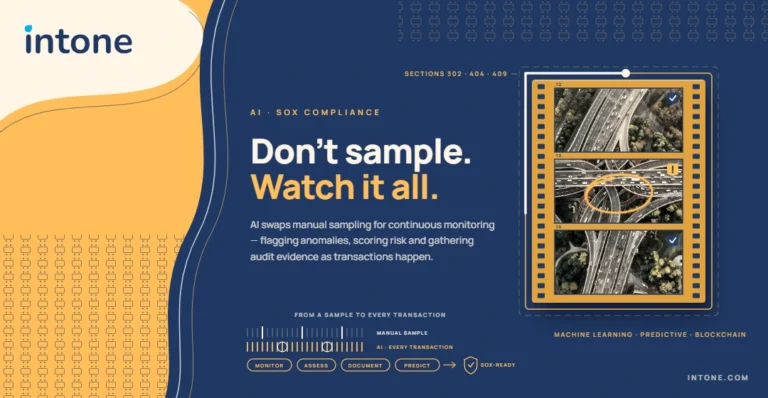
Beyond threat detection, continuous observation provides automated audit readiness. Rather than relying on periodic checks or manual sample gathering, robust security programs provide continuous evidence of collection. This level of audit readiness strengthens overall operational stability, satisfies regulatory compliance monitoring obligations, and provides auditors with verifiable proof of risk management.
Real-World Examples of High-Impact Data Breaches To understand the practical value of comprehensive security monitoring, one must look at past historical breaches where monitoring gaps led to extensive organizational damage.
- Target (2013 Data Breach)
In 2013, Target suffered a massive data breach that compromised the credit card information of approximately 40 million customers. The total cost of the breach reached about $292 million including settlements, legal fees, and recovery efforts. Target settled for $18.5 million with 47 states and faced numerous lawsuits, which further strained its finances. The breach also led to a nearly 50% drop in profits during the fourth quarter of 2013 compared to the previous year.
- Sony Pictures (2014 Cyber Attack)
In 2014, Sony Pictures experienced a cyber-attack that resulted in the leak of sensitive employee data and unreleased films. The estimated financial impact of this breach was around $100 million, factoring in costs related to system repairs, legal fees, and reputational damage. The incident prompted Sony to improve its cybersecurity measures significantly to prevent future attacks.
Enterprise Cloud Strategies: Microsoft Integration and Trust Security Design As modern workloads move to the cloud, securing cloud and infrastructure security parameters becomes paramount. Enterprise security programs must adapt to cover hybrid infrastructure, multi-cloud topologies, and SaaS ecosystems.
Cloud Security Posture Monitoring Across Microsoft Cloud Platforms
Organizations leveraging Microsoft cloud transformation services require automated visibility into configuration drift, access privileges, and identity boundaries. Integrating specialized cloud security posture monitoring capabilities ensures that cloud resources remain compliant and protected against misconfiguration.
Establishing Trust Architecture and Trust Security Design
Deploying a modern trust architecture requires shifting from implicit trust toward explicit validation. By applying trust security design principles across all connected tools, systems, and network nodes, organizations maintain strict access controls and enforce continuous identity verification across all user sessions.
Replacing Manual Periodic Checks with Automated Tools
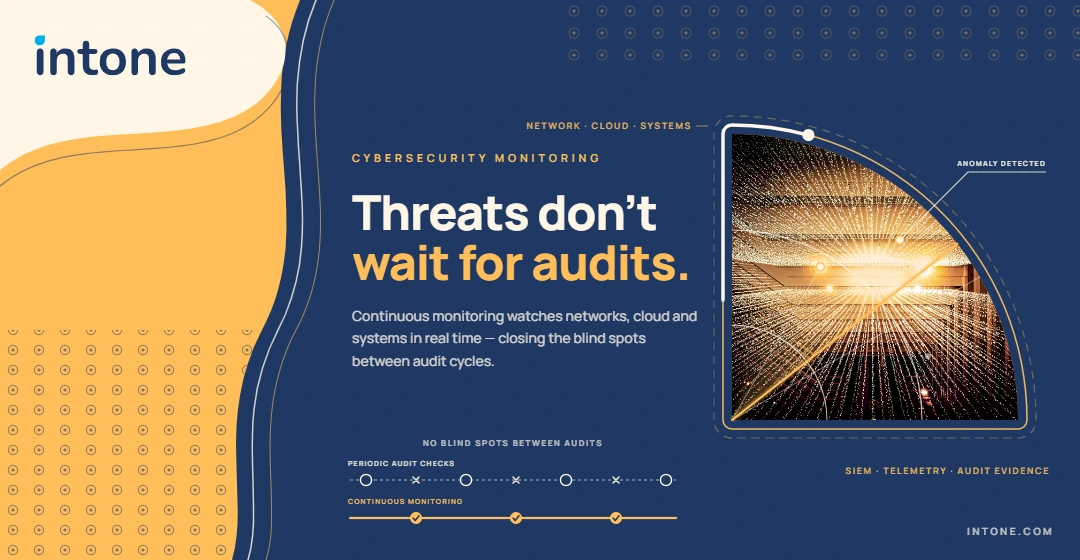
Relying solely on manual periodic checks leaves massive visibility gaps between audit cycles. Enterprise teams require specialized tools and automated frameworks to maintain continuous control monitoring across all operational assets, eliminating blind spots before adversaries can exploit them.
Why Choose Intone Continuous Control Monitoring (iCCM)?
Cyberattacks have become a major threat, with cybercrime increasing by 600% since the COVID-19 pandemic, highlighting the urgent need for secure IT infrastructure, GRC advisory alignment, and effective data management. Intone addresses this need with a comprehensive continuous control monitoring plan that offers an end-to-end enterprise platform integrating security, risk management, incident management, and compliance into one solution.
Seamless Multi-Source Integration Across Enterprise Systems
Our platform connects with over 240 industry-standard data sources and features a low-code/no-code interface for ease of use. Whether operating on-premises or across complex cloud environments, the IntoneGladius® platform provides unified observability across your technical stack.
Automated Risk Detection and Incident Resolution
Intone includes automated systems for risk management and incident resolution, real-time reporting, SSL and AES 256-bit encryption for data protection, and strong cybersecurity infrastructure.
Enterprise Cybersecurity Monitoring Services with Robotic Process Automation
We provide extensive regulatory compliance solutions to ensure adherence to current requirements while protecting sensitive data through robotic process automation. By unifying continuous threat detection, GRC advisory insights, and automated governance into an enterprise cybersecurity monitoring services model, Intone empowers organizations to build resilient, audit-ready systems.
FAQ’s
Cyber security monitoring is the continuous process of observing, tracking, and analyzing network traffic and system activity to identify and respond to potential security threats in real time.
Manual periodic checks leave visibility gaps between audit cycles. Continuous monitoring provides real-time risk detection and automated evidence of collection to prevent breaches before they spread.
Continuous controls monitoring automatically gathers evidence and evaluates compliance rules across connected systems, strengthening audit readiness, and eliminating manual audit prep.
Cloud security posture monitoring continuously checks for misconfigurations, unauthorized access, and policy drift across platforms like Microsoft Azure, maintaining system protection.
Intone (ICCM) connects to over 240 data sources, offering automated risk detection, real-time alerts, AES 256-bit encryption, and GRC compliance capabilities through a low-code/no-code platform.
Is your organization exposed to hidden security risks and compliance gaps between manual periodic checks?
Intone Continuous Control Monitoring (ICCM) delivers an end-to-end enterprise platform that unifies security, risk management, incident resolution, and compliance monitoring. Connecting with over 240 industry-standard data sources across hybrid and cloud environments, ICCM provides real-time threat detection, AES 256-bit encryption, and automated audit evidence gathering through an intuitive low-code/no-code interface. Eliminate security blind spots, maintain continuous control visibility, and ensure total regulatory compliance effortless.
Automate threat detection, eliminate audit preparation friction, and safeguard your critical assets with Intone Continuous Control Monitoring.