

Explore the leading applications of robotic process automation and how RPA helps organizations improve efficiency, productivity, customer service, and business processes.
Robotic Process Automation (RPA) uses software robots to automate repetitive, rule-based business processes across digital systems. Common applications include healthcare administration, supply chain operations, customer service, banking and financial services, human resources, data processing, and compliance activities. RPA can improve efficiency and productivity while reducing manual errors.
Robotic Process Automation (RPA) is a software technology that enables organizations to automate repetitive, rule-based tasks across digital systems and applications. RPA bots can interact with software in ways similar to human users, allowing organizations to automate processes that previously required significant manual effort.
The applications of RPA extend across industries and business functions. Healthcare organizations can use RPA for administrative processes, while financial institutions can automate banking and accounting activities. Supply chain teams can use automation to streamline repetitive workflows, and customer service departments can use software robots to process requests and update customer information.
RPA can also be combined with artificial intelligence (AI), machine learning (ML), and natural language processing (NLP) to create more advanced automation solutions. These approaches can extend automation beyond highly repetitive tasks to support more complex business processes.
Top RPA Applications at a Glance
Organizations can apply Robotic Process Automation (RPA) to a wide range of repetitive, rule-based processes, including:
- Data Entry and Data Transfer: Automating the movement of information between applications, databases, spreadsheets, and other digital systems.
- Finance and Accounting: Automating activities such as invoice processing, reconciliation, reporting, and transaction processing.
- Customer Service: Processing service requests, updating customer records, routing information, and supporting customer onboarding.
- Human Resources: Automating employee onboarding, record updates, document processing, and benefits administration.
- Healthcare Administration: Supporting patient registration, appointment scheduling, claims processing, billing, and document management.
- Supply Chain Management: Automating order processing, inventory updates, shipment tracking, invoice management, and reporting.
- Compliance and Risk Management: Supporting defined control activities, evidence collection, reporting, and other repetitive compliance workflows.
- Document Processing: Extracting, transferring, organizing, and validating information from structured digital documents.
What Is Robotic Process Automation?
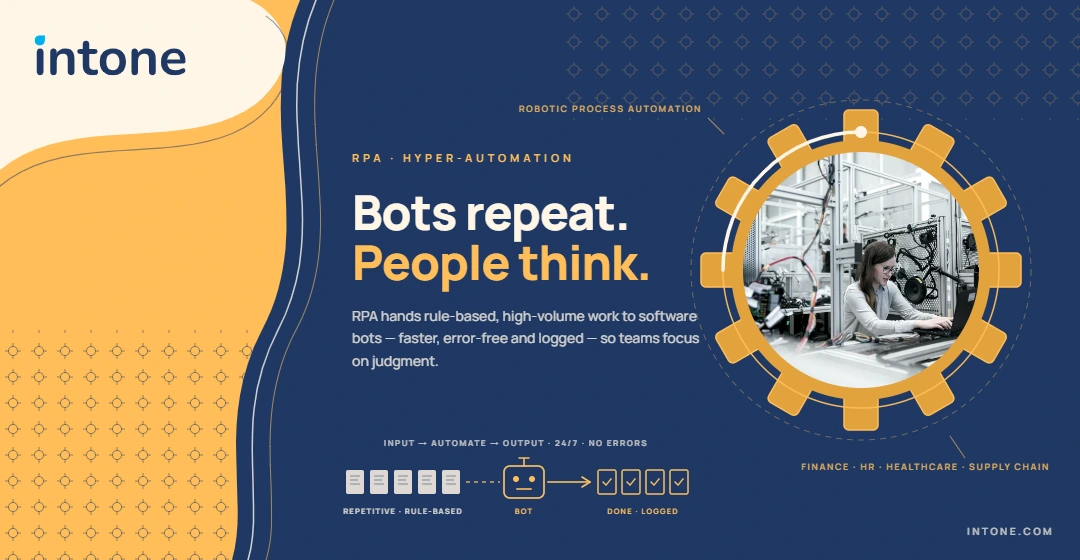
Robotic Process Automation uses software bots to perform repetitive and rule-based digital tasks. Rather than physically replacing employees, RPA automates defined interactions with software applications and systems.
Typical RPA tasks may include data entry, information retrieval, document processing, data validation, record updates, and routing information between systems.
The technology is particularly useful when a process follows predictable rules and involves high volumes of repetitive work. Automating these activities can allow employees to spend more time on tasks that require judgment, creativity, communication, and problem-solving.
Top Applications of Robotic Process Automation
RPA can be applied across a wide range of industries and business functions. Some of the most common applications include healthcare, manufacturing, supply chain management, retail, customer service, insurance, banking, and human resources.
- Robotic Process Automation in Healthcare
Healthcare organizations manage large volumes of patient information, documents, billing records, and administrative processes. Many of these activities are repetitive and can be standardized, making them potential candidates for process automation.
RPA can support activities such as patient registration, appointment scheduling, claims processing, billing, data entry, and document management. Automating these workflows can reduce manual effort and help employees focus on patient-facing and higher-value responsibilities.
RPA can also improve the movement of information between healthcare systems by automating defined data transfer activities. When implemented appropriately, automation can contribute to greater efficiency, accuracy, and productivity. - Robotic Process Automation in Manufacturing
Manufacturing organizations manage numerous repetitive processes across production, inventory, procurement, quality control, and administrative operations. Many of these activities involve structured data and rule-based tasks that can be suitable for process automation.
RPA can automate activities such as purchase order processing, inventory updates, invoice processing, production reporting, data entry, and document management. Software robots can transfer information between systems, update records, generate reports, and trigger predefined workflows.
By reducing manual intervention, RPA can help manufacturing organizations improve operational efficiency, processing speed, and data accuracy. Employees can then focus on activities requiring greater analysis, problem-solving, and decision-making rather than repetitive administrative tasks. - Robotic Process Automation in Supply Chain Management
Supply chain operations involve numerous repetitive processes, including order processing, inventory updates, invoice management, shipment tracking, and data entry.
RPA can automate repetitive supply chain tasks by transferring information between applications, updating records, generating reports, and triggering predefined workflows.
By reducing manual intervention, organizations can improve processing speed and minimize errors. Employees can then focus on activities requiring greater analysis and decision-making rather than spending time on repetitive administrative work. - Robotic Process Automation in Retail
Retail organizations manage high volumes of transactions, customer information, inventory records, invoices, and supplier data. Many of these processes involve repetitive administrative activities that can be standardized and automated using RPA.
RPA can support activities such as order processing, inventory updates, invoice processing, customer data management, returns processing, and sales reporting. Software robots can transfer information between applications, update records, generate reports, and trigger predefined workflows.
By reducing repetitive manual work, RPA can help retailers improve operational efficiency, processing speed, and data accuracy. Employees can then focus on customer service, merchandising, inventory planning, and other activities requiring human judgment and decision-making. - Robotic Process Automation for Customer Service
Customer service teams frequently manage high volumes of requests and information across multiple systems. RPA can help automate the administrative activities that support these interactions.
For example, software robots can collect information from different systems, update customer records, process service requests, and route information to the appropriate team.
RPA can therefore help improve customer service efficiency by reducing the time employees spend on repetitive back-office tasks. Faster processing and more consistent data handling can also contribute to a smoother customer experience.
Customer onboarding is another potential application. RPA can automate defined steps such as collecting information, entering customer records, validating data, and initiating predefined workflows.
- Robotic Process Automation in Insurance
Insurance companies manage large volumes of customer information, policy documents, claims, invoices, and regulatory records. Many insurance processes involve repetitive, rule-based activities that can be standardized and supported through process automation.
RPA can be used for activities such as claims processing, policy administration, customer data entry, document verification, premium processing, and reporting. Software robots can collect information from multiple systems, update records, validate predefined data fields, and initiate workflow steps.
By automating repetitive tasks, RPA can help insurance organizations reduce manual workloads while improving processing efficiency, consistency, and accuracy. Employees can spend more time on activities requiring judgment, such as complex claims assessment, customer interactions, and risk analysis.
- Robotic Process Automation in Banking and Financial Institutions
Banking and financial services are among the industries where RPA can provide significant value because many financial processes involve structured data and repetitive, rule-based activities.
Financial institutions can use RPA for activities such as account administration, transaction processing, data entry, reconciliation, reporting, invoice processing, and compliance-related workflows.
Automating these processes can help employees reduce manual workloads while improving processing speed and consistency. RPA can also create standardized workflows and maintain records of automated activities, which can support transparency and compliance requirements.
RPA may also support SOX automation by helping organizations automate defined control-related tasks, evidence collection, reporting, and other repetitive activities associated with compliance processes. The specific controls and requirements will depend on an organization’s internal control framework.
- Robotic Process Automation in Human Resources
Human resources departments manage a wide variety of repetitive administrative processes. RPA can help automate activities such as employee onboarding, updating employee records, processing documents, and managing benefits-related information.
For example, an RPA bot can transfer information from an employee form into multiple systems, reducing the need for HR employees to manually enter the same information repeatedly.
RPA can also support recruitment and onboarding workflows by automating defined administrative steps. This allows HR professionals to dedicate more time to employee engagement, organizational development, and other activities requiring human interaction.
Other Business Applications of Automation
The applications of RPA are not limited to the industries discussed above. Organizations can identify automation opportunities wherever repetitive, rules-based tasks consume significant employee time.
Common examples include:
- Finance and accounting: Invoice processing, reconciliations, reporting, and data entry.
- IT operations: User provisioning, system monitoring, ticket management, and routine administrative tasks.
- Compliance: Data collection, documentation, reporting, and predefined compliance workflows.
- Procurement: Purchase order processing, vendor information management, and invoice matching.
- Sales operations: CRM updates, lead processing, and data synchronization.
- Data management: Data extraction, validation, transformation, and transfer between applications.
The best candidates for automation are generally processes that are repetitive, rules-based, high-volume, and relatively stable. Organizations should evaluate each process individually before deciding whether RPA is the appropriate solution.
Benefits of Robotic Process Automation
Implementing RPA can provide several benefits when automation is applied to appropriate processes.
- Improved Efficiency and Productivity
RPA bots can perform repetitive tasks quickly and continuously without requiring manual intervention. Automating routine workflows can shorten processing times and help organizations handle larger volumes of work more effectively. - Fewer Manual Errors
Repetitive data entry and information transfer activities can be susceptible to human error. RPA can follow predefined rules consistently, helping reduce errors in suitable automated workflows and improving the reliability of processed information. - Greater Process Standardization
Automation can help organizations establish consistent execution of defined processes. Standardized workflows can make it easier to monitor performance, identify deviations, and maintain consistent procedures across business operations. - Greater Process Standardization
RPA can support compliance by executing predefined procedures consistently and creating records of automated activities. When combined with appropriate monitoring and governance, automation can provide greater visibility into business processes and support documentation requirements. - Better Customer Experience
Automating administrative tasks can allow customer-facing employees to spend more time addressing complex requests and customer needs. Faster processing and more consistent handling of information can contribute to a smoother and more responsive customer experience.
How to Identify the Right Processes for Automation
Not every business process should be automated. Organizations should first evaluate processes based on factors such as transaction volume, repetition, complexity, stability, error rates, and business impact.
A process may be a strong candidate for RPA when it:
- Involves repetitive tasks
- Follows clearly defined rules
- Requires frequent data entry or transfer
- Uses structured and accessible data
- Has predictable inputs and outputs
- Consumes significant employee time
- Experiences avoidable manual errors
Organizations should also consider security, compliance, integration requirements, and potential return on investment before implementing an automation solution.
Why Choose Intone for Your RPA Needs?
RPA can help organizations reduce manual workloads and improve the efficiency of repetitive business processes. However, successful implementation depends on identifying the right use cases and selecting automation technology that can work across an organization’s existing environment.
Intone provides RPA solutions designed to support front-end and back-end automation across enterprise processes.
Key capabilities include:
- Front-end RPA designed to automate customer-facing interactions
- Back-end RPA for repetitive and labor-intensive tasks
- Multilingual automation solutions
- Natural language processing for conversational interactions
- Omnichannel support through integration with commonly used customer-support channels
- Enterprise-grade security with encryption
- Data anonymization to help protect sensitive information
- End-to-end hyper-automation through a low-code engine
These capabilities can help organizations automate repetitive activities while allowing employees to focus on more strategic and higher-value work.
For a deeper look at RPA use cases, see Intone’s related resource, Top Applications of Robotic Process Automation.
Key Takeaways
- Robotic Process Automation uses software bots to automate repetitive, rule-based digital tasks.
- RPA has applications across healthcare, supply chain, customer service, banking, financial services, HR, and other industries.
- Automation can improve efficiency, productivity, consistency, and processing speed.
- RPA can reduce manual errors in appropriate, rules-based workflows.
- Customer onboarding, customer service, compliance, finance, and data management are potential RPA use cases.
- SOX automation can support defined compliance and control-related activities.
- Not every process is suitable for RPA; organizations should evaluate complexity, stability, volume, and business value before automating.
- RPA can be combined with AI, ML, and NLP to create more advanced automation solutions.
Real-World Examples of RPA
Organizations across industries use Robotic Process Automation to automate repetitive, rule-based processes and reduce manual work. Examples of RPA applications include:
- Healthcare: Helse Vest, a Norwegian healthcare organization, has used RPA to automate administrative processes, helping reduce the time clinicians spend on repetitive tasks.
- Banking and Financial Services: Heritage Bank has implemented RPA across operations and payment processes, demonstrating how automation can support repetitive banking activities.
- Insurance: Länsförsäkringar Stockholm has used RPA to automate more than 40 processes, including claims processing and other repetitive insurance workflows.
- Manufacturing and Supply Chain: Schneider Electric has implemented RPA within its global supply chain to automate repetitive tasks and support more efficient operations.
These examples demonstrate how RPA can be applied to high-volume, repetitive processes across industries while allowing employees to focus on tasks that require greater judgment and human interaction.