

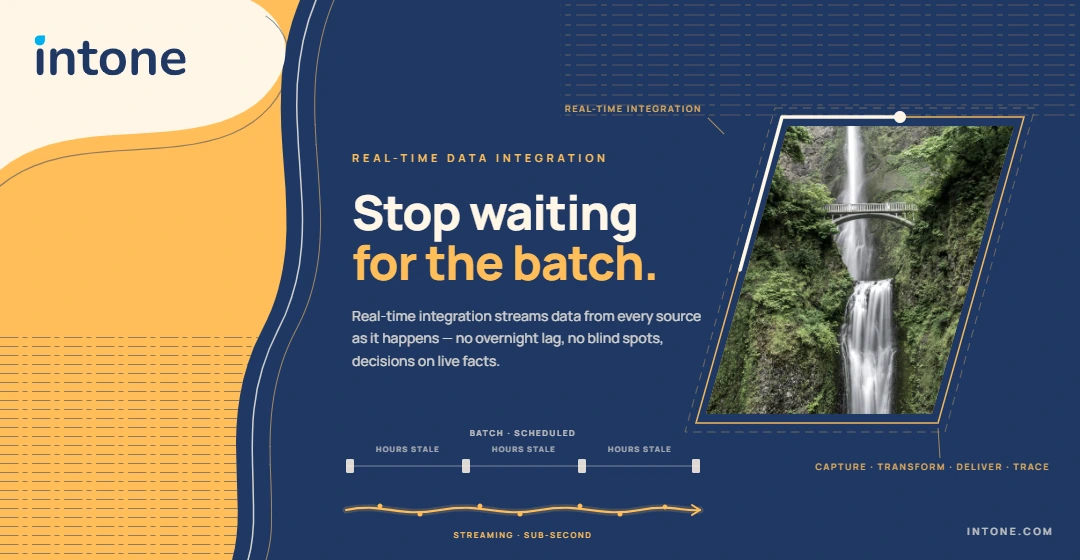
How continuous streaming architectures break down silos, accelerate insights, and future-proof modern enterprise operations.
What Is Real-Time Data Integration?
Real-time data integration is the continuous process of capturing, transforming, and delivering data from disparate sources into target systems with minimal latency, helping organizations access current information for faster decision-making.
Real-time data integration continuously captures, transforms, and delivers streaming data from disparate sources into target analytics platforms with sub-second latency. It enables modern organizations to eliminate operational blind spots, accelerate executive decision-making, and support continuous governance and compliance monitoring.
Publishing Note to Developer: Please ensure the Featured Snippet and the Introduction are presented as two distinct content elements, not as a continuation of the same section.
Data is increasing rapidly across every sector. Over 80% of respondents in recent research by IBM reported a dramatic surge in the volume, variety, and velocity of data they handle. Consequently, the demand for advanced data and analytics skills is growing rapidly—data analysts and scientists topped the World Economic Forum’s list of most in-demand jobs worldwide.
However, major obstacles remain for modern organizations. Analysts often lack high-quality, timely access to information, as well as the specialized tools required to unify disparate data sources. Traditional batch processing techniques are no longer fast enough to meet modern real-time operational needs.
This explains the growing interest in real-time continuous pipelines. Unlike static batch methods, real-time integration powers rapid decision-making, breaks down operational silos, and future-proofs organizations against rapid market changes.
Many audit, risk, and analytics leaders find themselves facing a frustrating operational dilemma:
“Our analysts spend more time reconciling delayed batch data than driving strategic execution. How can we modernize our ingestion frameworks to achieve instant enterprise visibility?”
Transitioning from historical batch processing to continuous streaming provides the foundational capability required to solve this operational friction.
What is Realtime Data Integration and Why Does It Matter?
Many organizations begin their data modernization journey expecting immediate agility simply by moving workloads to cloud warehouses.
From an operational perspective, that expectation makes sense as cloud architectures offer massive scalability.
However, infrastructure upgrades alone do not automatically solve information latency.
Real-time data integration is the process of continuously capturing, transforming, and delivering continuous streams from disparate sources into a target system with minimal latency. It ensures enterprise users maintain access to the most up-to-date, integrated information for faster and better-informed decision-making.
Organizations evaluating different approaches can also explore data integration tools, features, benefits, and use cases to understand the capabilities required for modern integration environments.
As a result, organizations using outdated batch schedules encounter significant barriers to agility. The issue is rarely whether individual systems contain valuable data, but whether the business can unify and act on that data in real time.
When that speed is missing, decisions remain reactive, operational risks go undetected, and competitive advantages diminish.
Batch Processing vs. Real-Time Data Integration
For non-technical decision-makers, the difference between batch processing and real-time integration is primarily about when data becomes available for action:
| Batch Processing | Real-Time Data Integration |
| Data is collected and processed at scheduled intervals. | Data is captured and processed continuously as events occur. |
| Information may be hours or days old when analyzed. | Information is available with minimal latency. |
| Best suited for periodic reporting and historical analysis. | Well suited for operational monitoring and time-sensitive decisions. |
| Issues may only become visible after the next processing cycle. | Teams can identify emerging issues as new data arrives. |
| Updates can create delays between source systems and analytics platforms. | Continuous streams keep target systems more closely aligned with current activity. |
The choice does not always have to be either-or. Many enterprises use batch processing for historical workloads while introducing real-time integration where operational speed and current information are critical.
Accelerating Digital Transformation with Realtime Data Access
Behind every demand for instant analytical output, system architects are trying to answer a handful of practical questions.
When evaluating real-time integration frameworks, engineering teams want to understand:
- Where did the data originate?
- Were any transformations made to the data?
- Who or what generated the record?
- Can the process be reproduced consistently?
- Is there a complete record demonstrating how the result was achieved?
These questions validate the end-to-end data journey across enterprise systems.
Modern enterprise systems demand visibility into live transactional events, equipment sensors, financial transactions, and digital customer channels rather than periodic snapshots.
And that is where traditional architectures fall short.
Without specialized technologies capable of streaming from transactional databases, cloud applications, and IoT edge devices simultaneously, organizations struggle to unlock continuous efficiency. By taking raw inputs, normalizing them immediately, and pushing them into target data warehouses or event hubs, companies avoid the blind spots of legacy infrastructure.
For organizations managing complex environments, IT systems integration can help connect applications, systems, and data flows across the enterprise.
How Realtime Data Powers Rapid Enterprise Decision-Making
Most decision-making bottlenecks occur not because raw data is missing, but because information is trapped in delayed batch pipelines.
This is where real-time streaming platforms like Apache Kafka, AWS Kinesis, Azure Event Hubs, Snowflake, and BigQuery become essential.
Feeding continuous streams into operational engines empowers teams to uncover actionable insights rapidly across key use cases:
- Fraud Detection: Identifying suspicious financial transactions in real time to help identify suspicious transactions before significant losses occur.
- Dynamic Inventory Monitoring: Tracking supply chain movements continuously across distributed fulfillment centers.
- Personalized Recommendations: Delivering tailored content or offer updates to digital users based on real-time behavior.
Think of real-time streaming as a continuous neural network for enterprise data.
Just as operational leaders need immediate feedback on critical functions, analytics engines require continuous telemetry to drive automated actions.
Without continuous streaming architectures, organizations remain trapped evaluating historical metrics after issues have already impacted performance.
Speed becomes a primary competitive differentiator.
Overcoming Isolated Data Silos with Unified Streaming
The importance of unified visibility is only increasing across complex enterprise environments.
Data silos across legacy applications like ERP and CRM systems present a persistent obstacle to organizational decision-making. Research demonstrates that unified data access across departments significantly improves operational efficiency and clinical workflows in sectors like healthcare.
As systems become more interconnected, expectations for unified data visibility continue to rise.
The growing reliance on automated workflows makes real-time integration across silos even more critical.
Integrating real-time streams across legacy databases, system log files, and edge device telemetry provides a 360-degree operational view.
Regardless of the underlying application architecture, one principle remains constant:
Decision-makers must have access to fresh, consolidated insights.
Prevent Vendor Lock-In Through Multi-Cloud Integration
If enterprises remain locked into single-cloud vendors, adding more proprietary tools is not necessarily the answer.
A more effective approach is standardizing data flows across diverse cloud providers and on-premises systems.
Organizations pursuing multi-cloud flexibility should build integration environments that incorporate key structural capabilities:
- Enterprise Knowledge Graph
Complete visibility across all active integrations and system dependencies. - Extensive Connector Library
Access to robust connector frameworks supporting:
- Applications
- Databases
- Edge devices
- Legacy data stores
- Cloud APIs
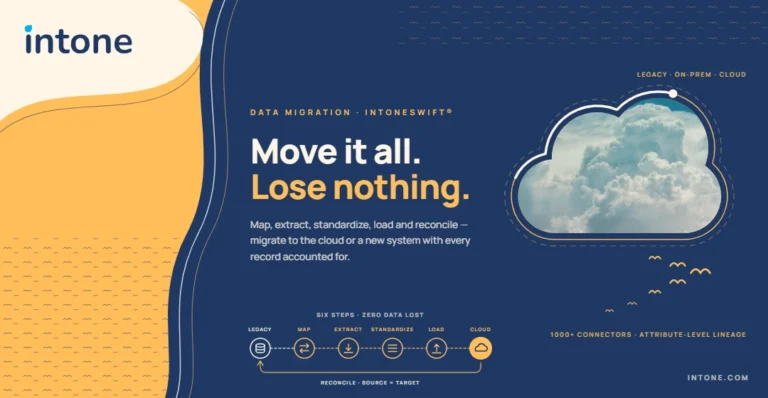
- Having 1000+ pre-built connectors accelerates deployment and reduces custom engineering overhead.
- Low-Code / No-Code Interface
Intuitive visual platform designed for rapid workflow creation and management. - High-Performance Architecture
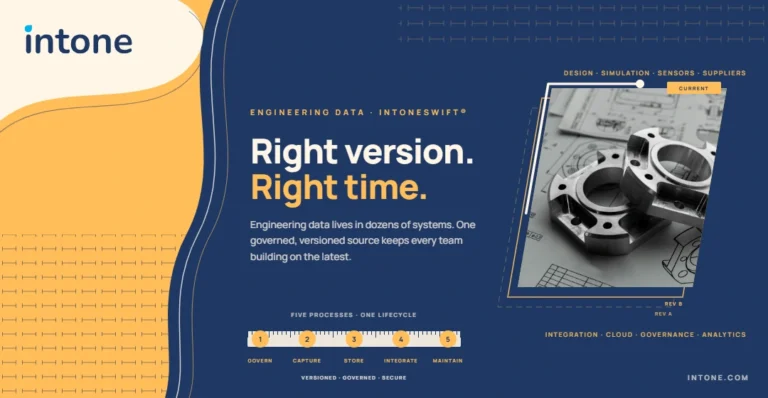
Distributed in-memory engines delivering up to 10x faster execution for complex data operations. - Attribute-Level Lineage
Granular visibility tracking data lineage at every step of your data integration map.
As enterprises expand their cloud footprint, integration strategies also need to account for cloud modernization. Organizations can explore Microsoft Cloud Business Transformation when evaluating how cloud capabilities can support broader digital transformation initiatives.
Driving Continuous Controls Monitoring for Modern GRC Advisory
Many organizations view basic data pipelines as the finish line for integration initiatives.
In reality, simple data ingestion is only one part of modern architecture.
The greater challenge is establishing continuous controls monitoring for governance, risk, and compliance (GRC) advisory frameworks.
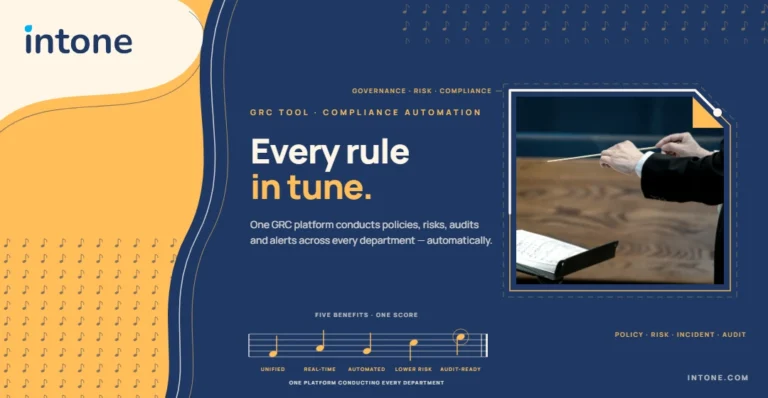
Intone Solutions helps organizations capture continuous streams, preserve traceability, maintain audit trails, and establish real-time policy adherence. By leveraging continuous controls monitoring, compliance teams automatically track policy adherence across systems to mitigate operational, security, and regulatory risks before they escalate.
Organizations looking to strengthen this capability can explore GRC Monitoring Services for continuous oversight of governance, risk, and compliance activities.
That distinction matters.
When compliance teams and executive leaders gain real-time visibility across live streams, they shift from reactive auditing to proactive risk management.
For organizations that need broader governance and risk support, GRC Advisory can complement real-time monitoring by helping align governance, risk, compliance, and audit-readiness requirements.
Machine Learning and Predictive Analytics Driven by Continuous Data Streams
The conversation around enterprise decision-making is changing.
Not long ago, success was measured by periodic reporting schedules and static dashboards.
Today, leading organizations rely on continuous real-time data to drive live machine learning models and predictive analytics:
- Enhanced Model Precision: Training and scoring models on live operational inputs can help improve model accuracy over time.
- Automated Risk Mitigation: Combining predictive analytics with continuous anomaly detection allows automated systems to take corrective actions instantly.
Applying automation across real-time pipelines minimizes human intervention, accelerating time-to-insight and boosting overall performance.
Organizations exploring enterprise AI capabilities can also consider AI Enablement to support the integration of AI technologies into modern business environments.
Ultimately, the goal is not simply to ingest data, but to inspire confident, rapid execution.
Why Choose Intone for Your Data Integration Journey?
If your organization has invested in legacy pipelines but still faces data latency, isolated silos, or delayed reporting cycles, it may be time to evaluate the underlying integration framework.
Discover how Intone Solutions delivers specialized platform capabilities—including multi-cloud streaming, end-to-end security, attribute-level lineage, and real-time monitoring modules—to help your organization achieve agile decision-making.
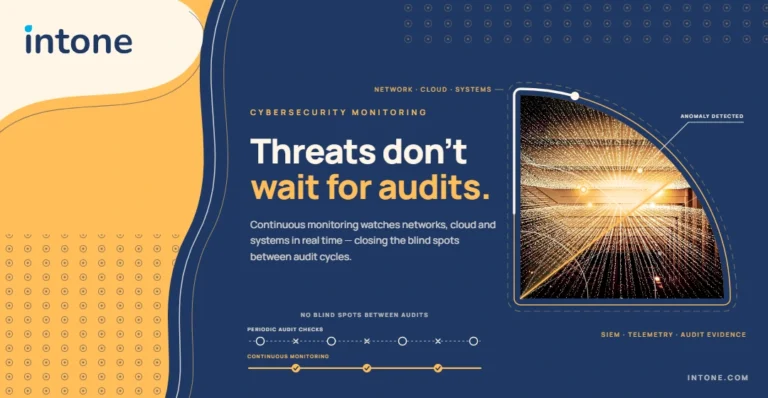
Organizations can strengthen their broader technology environment through cybersecurity monitoring to maintain continuous visibility across infrastructure, cloud environments, identities, and critical systems.
For enterprises seeking a unified approach to security, risk, compliance, and data operations, IntoneGladius® provides a centralized platform designed to support real-time monitoring and enterprise control management.
Contact Intone today to schedule a demo and see real-time data integration solutions in action.
Key Takeaways
- Real-time data integration continuously connects data sources and target systems, helping organizations access current information for faster operational decisions.
- Streaming architectures can reduce the limitations of data silos and delayed batch processing, improving visibility across enterprise systems.
- Real-time integration supports time-sensitive use cases such as fraud monitoring, inventory management, personalized experiences, and operational analytics.
- Continuous data streams can strengthen machine learning and predictive analytics workflows by providing models with fresher operational inputs.
- Real-time integration can support continuous governance, risk, and compliance monitoring, helping organizations move toward more proactive oversight.
Is delayed batch data slowing down your executive decisions and leaving operational blind spots across your business?
Accelerate your operations with Intone Solutions. Our real-time data integration framework leverages continuous streaming architectures, multi-cloud flexibility, and over 1000 pre-built connectors to deliver sub-second data delivery, eliminate silos, and automate continuous controls monitoring.
Break Down Data Silos and Drive Real-Time Enterprise Execution Today.