

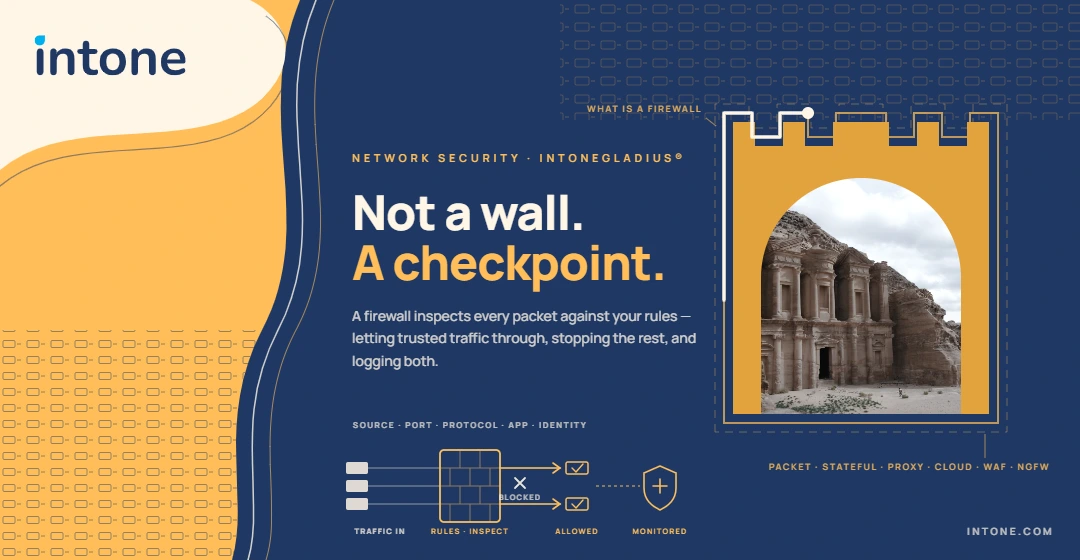
Learn how firewalls protect networks from cyber threats, how they filter network traffic, and the different types of firewalls used in modern cybersecurity.
A firewall in cybersecurity is a network security device or software solution that monitors and controls incoming and outgoing network traffic according to a defined set of security rules. Firewalls act as a barrier between trusted and untrusted networks, helping prevent unauthorized access, malicious traffic, and potential cyber attacks.
As organizations become increasingly dependent on connected systems, protecting digital environments from external and internal threats has become essential to effective network security. A firewall is one of the foundational security controls used to protect a computer network and its connected devices.
Firewalls monitor network traffic and apply predefined rules to determine whether data should be allowed or blocked. By controlling traffic between networks, a firewall can help organizations reduce exposure to unauthorized access, malicious activity, and other potential threats.
Modern firewalls have evolved significantly from the simple packet-filtering technologies used in early networks. Today’s solutions can incorporate stateful inspection, application-level filtering, intrusion detection and prevention capabilities, cloud-based protection, and advanced threat management.
Understanding the firewall definition, its history, and the different types of firewalls available can help organizations select the right firewall protection for their security requirements.
What is a Firewall?
A firewall is a security mechanism that monitors and controls network traffic based on a defined set of security rules.
Firewalls are positioned between networks or systems with different levels of trust. For example, an organization may use a firewall to control traffic between its private internal network and external networks such as the public internet.
When network traffic reaches a firewall, the firewall evaluates information associated with the traffic and determines whether the connection or data packet should be permitted or blocked.
Firewall in Network Security
The role of a firewall in network security is to establish a controlled boundary between trusted and untrusted environments.
A firewall can regulate both incoming and outgoing traffic. This allows organizations to establish rules governing which systems, users, applications, ports, and network connections can communicate with one another.
Firewalls therefore provide an important layer of defense against external threats. However, they are only one part of a broader cybersecurity strategy and should be combined with other security controls.
History of Firewalls
The history of firewalls began with relatively simple mechanisms for controlling network access. Early firewall technologies primarily examined individual data packets and applied basic rules based on information such as source and destination addresses.
As computer networks became more complex, firewall capabilities evolved. Stateful inspection allowed firewalls to consider the context and state of network connections rather than examining packets independently.
Later generations introduced more sophisticated application-level inspection, intrusion prevention, identity-based controls, and advanced threat detection.
Today, modern firewalls can operate across physical, virtual, cloud, and application environments. Organizations can therefore select firewall solutions based on the architecture and security requirements of their environments.
How Does a Firewall Work?
A firewall works by examining network traffic and applying predefined security rules.
When a data packet or connection reaches the firewall, the firewall evaluates relevant information and compares it with its configured rules. Depending on those rules, the traffic may be permitted, rejected, or dropped.
Incoming and Outgoing Traffic
Firewalls can control both incoming and outgoing network traffic.
Incoming traffic may be evaluated to determine whether an external system should be permitted to communicate with an internal resource. Outgoing traffic can also be monitored to prevent unauthorized systems or applications from communicating with external destinations.
Controlling outgoing traffic can be particularly useful when an organization needs to restrict applications or systems from communicating with potentially malicious destinations.
Firewall Rules
Firewall rules define the conditions under which traffic is allowed or blocked.
Rules can be based on factors such as:
- Source IP address
- Destination IP address
- Network protocol
- Ports
- Connection state
- Application
- User or identity
- Traffic direction
A well-designed set of security rules should reflect an organization’s security policies and business requirements. Rules should also be reviewed regularly to ensure that outdated or unnecessary access does not remain enabled.
Types of Firewalls
There are several different types of firewalls, each designed to address different security requirements and network architectures.
Packet Filtering Firewall
A packet filtering firewall is one of the most basic types of firewalls. It examines individual data packets and makes decisions based on characteristics such as source address, destination address, protocol, and port.
Packet filtering can be effective for straightforward access-control requirements, but it generally provides less context than more advanced firewall technologies.
Stateful Inspection Firewall
A stateful inspection firewall monitors the state of network connections in addition to examining individual packets.
Unlike basic packet filtering, stateful firewalls can determine whether a packet belongs to an established connection. This allows the firewall to make more informed traffic decisions based on the context of the connection.
Stateful inspection remains an important technology for network security and is incorporated into many modern firewall solutions.
Proxy Firewall
A proxy firewall acts as an intermediary between users or systems and external resources.
Instead of allowing a client to communicate directly with an external destination, the proxy receives and forwards requests on the client’s behalf. This can provide an additional layer of control and visibility between internal and external networks.
Proxy firewalls can also perform inspection at higher levels of the network stack, depending on their configuration and capabilities.
Hardware Firewall
A hardware firewall is a physical network security device positioned within a network infrastructure.
Hardware firewalls can protect multiple systems behind a common network boundary and are often deployed at network perimeters or between network segments.
They can be particularly useful for organizations managing larger environments where centralized network traffic control is required.
Software Firewall
A software firewall operates as software on an individual computer, server, or endpoint.
Software firewalls can provide host-level protection and allow organizations to establish rules for traffic entering or leaving a particular device.
Because they operate directly on endpoints, software firewalls can complement perimeter and network-level controls.
Virtual Firewall
A virtual firewall is a software-based firewall deployed within a virtualized environment.
Virtual firewalls can help organizations maintain security controls as infrastructure becomes increasingly virtualized. They can be deployed between virtual networks, workloads, or other logical environments.
Cloud Firewall
A cloud firewall provides firewall protection within cloud-based infrastructure.
As organizations move workloads and applications to cloud environments, traditional perimeter-based security models may not be sufficient by themselves. Cloud firewalls can provide traffic filtering and access controls appropriate to cloud architectures.
Web Application Firewall
A Web Application Firewall (WAF) is specifically designed to protect web applications by inspecting application-layer traffic.
A WAF can help organizations identify and block malicious requests targeting web applications. It can provide protection against certain application-level attacks and complement broader network firewall controls.
Because a WAF focuses on the web application layer, it serves a different purpose from a traditional network firewall.
Next-Generation Firewalls
Next-generation firewalls (NGFWs) combine traditional firewall functionality with more advanced inspection and security capabilities.
Depending on the solution, NGFWs may include application awareness, intrusion prevention, advanced traffic inspection, identity-based controls, malware detection, and other threat protection capabilities.
These capabilities allow organizations to move beyond basic port and packet filtering toward more comprehensive threat management.
Firewall Protection Against Cyber Attacks
Firewalls provide an important layer of defense against cyber attacks by controlling how systems communicate with one another.
A firewall can block unauthorized connections, restrict access to specific ports, and prevent traffic that violates established security rules.
However, firewalls should not be considered a complete cybersecurity solution. Attackers can exploit vulnerabilities through legitimate-looking traffic, compromised credentials, malicious files, social engineering, or application-level weaknesses.
Organizations should therefore combine firewall security with additional security controls such as endpoint protection, identity and access management, intrusion detection and prevention, vulnerability management, security monitoring, and incident response.
Firewall Security and Network Segmentation
Firewalls can also support network segmentation by controlling communication between different portions of an internal network.
For example, an organization may separate sensitive databases, employee systems, development environments, and public-facing applications into different network segments.
An internal firewall can then control traffic between those segments according to the organization’s security policies.
Segmentation can reduce the ability of an attacker to move laterally through a network after gaining unauthorized access to one system.
Firewalls and Threat Management
Effective firewall security increasingly involves more than blocking traffic based on IP addresses and ports.
Modern organizations face a broad threat landscape involving malware, ransomware, unauthorized access attempts, application attacks, credential abuse, and other forms of malicious activity.
Advanced firewall capabilities can help organizations identify suspicious traffic and enforce more detailed security policies.
When integrated with broader cybersecurity monitoring, firewall data can also contribute to threat management and incident investigation.
Firewall vs. Other Security Controls
A firewall should be understood as one component of a larger cybersecurity architecture.
Firewall vs. Intrusion Detection
A firewall primarily controls network traffic according to security rules. An intrusion detection system focuses on identifying potentially suspicious or malicious activity.
These technologies can complement one another. A firewall may block traffic based on predefined rules while an intrusion detection system identifies patterns that may indicate an attack.
Firewall vs. Antivirus
Antivirus and endpoint security solutions primarily protect individual systems from malicious software and other endpoint threats.
A firewall operates primarily at the network or host-communication level. Using both technologies can provide broader protection.
Firewall vs. Web Application Firewall
A traditional network firewall controls network traffic, while a web application firewall focuses specifically on traffic targeting web applications.
Organizations operating public-facing applications may therefore use both technologies as part of a layered security architecture.
How to Choose the Right Firewall
Selecting the right firewall depends on the organization’s infrastructure, applications, security requirements, risk profile, and regulatory obligations.
Organizations should consider:
- Network architecture: Determine whether protection is needed at the perimeter, internally, in the cloud, or across multiple environments.
- Traffic volume: Evaluate whether the firewall can handle expected network traffic without creating performance bottlenecks.
- Application requirements: Determine whether application-level inspection is necessary.
- Scalability: Consider how firewall requirements may change as the organization grows.
- Integration: Evaluate compatibility with existing security tools and infrastructure.
- Management: Consider how easily security teams can configure, monitor, and maintain firewall rules.
- Threat protection: Evaluate advanced capabilities such as intrusion prevention and application awareness.
- Compliance: Ensure that the firewall can support relevant security policies and regulatory requirements.
A firewall should ultimately be selected as part of a broader network security strategy, rather than as an isolated technology purchase.
Best Practices for Firewall Security
Organizations can improve firewall security by following several practical best practices.
Establish Clear Security Rules
Firewall rules should be based on documented security policies and business requirements. Organizations should avoid unnecessary access and ensure that rules are specific enough to limit exposure.
Review Rules Regularly
Firewall rules can become outdated as systems, applications, and business requirements change. Regular reviews can help identify redundant, overly permissive, or obsolete rules.
Restrict Unnecessary Access
Organizations should follow the principle of least privilege wherever practical. Systems and users should only receive the network access required to perform legitimate business activities.
Monitor Firewall Activity
Monitoring firewall logs and alerts can help security teams identify unusual network traffic, repeated access attempts, and other potential indicators of compromise.
Integrate Firewalls With Other Security Controls
Firewalls are most effective when integrated into a broader security architecture that includes identity controls, endpoint protection, vulnerability management, intrusion detection, security monitoring, and incident response.
Why Firewall Security Matters
Organizations rely on networks to connect employees, customers, applications, databases, cloud services, and business partners. This connectivity creates significant opportunities for productivity and collaboration, but it also increases exposure to potential threats.
A firewall provides an important protective barrier by controlling network communication and restricting unauthorized access.
When properly configured and maintained, firewalls can support effective network security by limiting unnecessary exposure, enforcing security policies, and providing visibility into network traffic.
However, firewall protection should always be considered part of a defense-in-depth strategy. No single security control can protect an organization against every threat.
Why Choose IntoneGladius®?
Managing firewall activity across complex environments can become challenging as organizations adopt cloud services, distributed infrastructure, remote access, and increasingly interconnected applications.
IntoneGladius® provides governance, risk, and compliance capabilities that can help organizations improve visibility into security controls and compliance activities.
The platform can support organizations by centralizing control information, monitoring security-related activity, and providing greater visibility into potential risks and compliance requirements.
Combining firewall security with broader control monitoring can help organizations establish a more comprehensive approach to cybersecurity, threat management, and compliance.
For additional information, see Intone’s related resource, Understanding the Role of Firewall in Cybersecurity.
Contact Intone to learn more about IntoneGladius® and strengthening your organization’s cybersecurity controls.
Key Takeaways
- A firewall acts as a barrier between trusted and untrusted networks.
- Firewalls monitor incoming and outgoing network traffic according to defined security rules.
- Common types include packet filtering, stateful inspection, proxy, hardware, software, virtual, cloud, web application, and next-generation firewalls.
- Firewalls can help protect organizations against unauthorized access and malicious traffic.
- Network segmentation can use firewalls to control communication between internal environments.
- A web application firewall protects web applications at the application layer.
- Modern firewalls may provide advanced threat management and inspection capabilities.
- Firewall rules should be regularly reviewed and updated.
- Firewalls should be combined with other security controls as part of a defense-in-depth cybersecurity strategy.
FAQ’s
A firewall is a security mechanism that monitors and controls network traffic based on predefined security rules. It can help prevent unauthorized access and malicious traffic from reaching protected systems.
Firewalls help establish a controlled boundary between trusted and untrusted environments. By filtering network traffic, they can reduce unauthorized access and limit exposure to external threats.
The main types include:
- Packet filtering firewalls
- Stateful inspection firewalls
- Proxy firewalls
- Hardware firewalls
- Software firewalls
- Virtual firewalls
- Loud firewalls
- Web application firewalls
- Next-generation firewalls
A packet filtering firewall examines individual data packets and applies rules based on information such as source and destination addresses, protocols, and ports.
A stateful inspection firewall evaluates network traffic based on the state and context of network connections rather than examining individual packets in isolation.
A web application firewall, or WAF, is designed to protect web applications by inspecting application-layer traffic and identifying potentially malicious requests.
A next-generation firewall combines traditional firewall functionality with advanced capabilities such as application awareness, deeper traffic inspection, intrusion prevention, and other threat protection technologies.
No. A firewall is an important security control, but it cannot prevent every type of cyber attack. Organizations should use firewalls alongside endpoint security, identity controls, vulnerability management, monitoring, and incident response.
Firewall rules should be reviewed regularly and whenever there are significant changes to network architecture, applications, users, or security requirements. Regular reviews can help remove unnecessary or outdated access.