

Explore how database management in cloud computing helps organizations improve scalability, security, reliability, flexibility, and data management.
Database management in cloud computing allows organizations to store, organize, process, and access data through scalable cloud-based systems. Cloud databases can reduce infrastructure costs, improve reliability, support data integration, and provide greater flexibility while also requiring organizations to consider security, performance, compliance, vendor lock-in, and data governance.
Data is central to modern businesses. Organizations rely on databases to store information, support applications, analyze trends, and make informed decisions. As data volumes continue to grow, traditional on-premises infrastructure can become more difficult and expensive to scale.
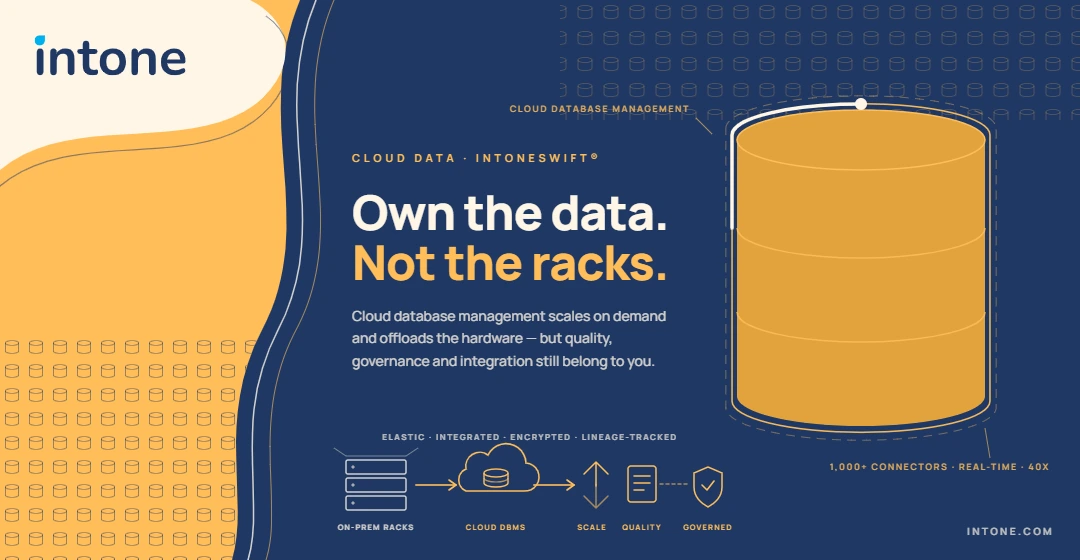
Cloud computing provides an alternative by allowing organizations to manage databases through cloud infrastructure rather than maintaining all of the underlying hardware themselves. Cloud-based database management can provide scalability, flexibility, and access to managed infrastructure while reducing some of the responsibilities associated with traditional database environments.
Understanding Cloud-Based Database Management Systems
A cloud-based database management system (DBMS) operates within a cloud environment and allows organizations to store and manage their databases without maintaining physical database infrastructure themselves.
Instead of making large upfront investments in hardware, software, and dedicated infrastructure maintenance, organizations can use cloud resources according to their needs. This can make it easier to scale storage and processing capacity as requirements change.
Cloud database management can also support different deployment models and integrations, giving organizations flexibility when building their technology environments.
The Rise of Cloud Databases and Data Integration
Cloud databases have become increasingly important as organizations manage larger volumes of information and adopt more digital applications.
One reason for this growth is the need to connect information across different systems. Data integration allows organizations to move and combine information from databases, applications, files, and other sources so it can be used more effectively.
For organizations working with large datasets, cloud environments can also support big data analytics, predictive analytics, and other data-driven applications. The goal is not simply to store more information, but to make that information easier to access and use.
Advantages of Cloud Database Management
Cloud database management can provide several practical benefits for organizations.
- Enhanced Database Scalability
Cloud databases can scale up storage and processing resources based on changing demand. Organizations can increase capacity during periods of high usage and reduce resources when demand decreases.
This flexibility can be especially useful for businesses experiencing rapid growth or fluctuating workloads. - Reduced Infrastructure Costs
Traditional database environments can require significant investments in servers, software, maintenance, and IT resources.
Cloud database management shifts much of this infrastructure responsibility to cloud providers. Depending on the provider and usage model, organizations can pay for the resources they need rather than maintaining extensive physical infrastructure. - Improved Database Security
Cloud providers typically offer security capabilities such as encryption, access controls, backup systems, and disaster recovery measures.
However, organizations still need to establish appropriate security practices for their specific environments. Security should remain an ongoing responsibility, particularly when databases contain sensitive or regulated information. - Greater Database Reliability
Cloud providers can use geographically distributed infrastructure and redundancy to help maintain availability.
For organizations that rely on databases to support applications and business operations, improved availability can reduce disruption and help ensure that critical information remains accessible.
- Increased Flexibility and Integration
Cloud database environments can support different database technologies, deployment models, and integrations.
This flexibility allows organizations to select technologies that align with their business goals and connect data with the applications that depend on it.
- Simplified Database Management
Cloud providers manage much of the underlying infrastructure, allowing IT teams to spend less time maintaining physical database environments.
This can give teams more time to focus on applications, analytics, data quality, and other activities that directly support business needs.
Data Quality and Data Quality Management
Moving databases to the cloud does not automatically make information accurate or useful. Organizations still need effective processes for maintaining the quality of their data.
Data quality management helps organizations identify problems such as incomplete, inconsistent, duplicated, or outdated information. Effective data quality management can make information more reliable for reporting, analytics, and operational processes.
Better data quality can also support a stronger business decision process. When employees can trust the information they are using, they can make decisions with greater confidence.
Organizations interested in healthcare applications can also explore the key components of data quality management in healthcare, where data quality can have implications for healthcare data, analytics, and patient outcomes.
Data Governance and Cloud Database Management
Governance becomes increasingly important as organizations manage data across multiple cloud platforms and applications.
Data governance establishes processes and responsibilities for how data is collected, managed, protected, and used. It can help organizations maintain consistent standards for data quality, security, access, and compliance.
A strong governance approach also helps organizations connect technology decisions to broader business goals. Instead of treating databases as isolated systems, organizations can manage them as part of a larger data strategy.
Considerations for Cloud Database Management
Cloud database management offers significant advantages, but organizations should also evaluate several important considerations before moving their databases to the cloud.
- Vendor Lock-In
Moving data between cloud providers can be complex. Organizations should consider their long-term requirements and understand how easily their databases and applications can be moved if business needs to change. - Security and Privacy
Cloud environments can provide strong security capabilities, but organizations must still configure appropriate protections. Access controls, encryption, authentication, and monitoring should be considered when managing sensitive information.
Healthcare organizations, for example, may need to pay particular attention to healthcare data and applicable privacy and security requirements. - Database Performance
Network latency and application architecture can affect database performance in cloud environments.
Organizations should evaluate connectivity, workload requirements, database design, and infrastructure before migrating critical applications. - Compliance and Data Residency
Different industries and regions may have specific requirements governing how information is stored and processed.
Organizations should understand relevant compliance obligations, data residency requirements, and other security topics before selecting a cloud database provider.
Why Choose IntoneSwift®?
Cloud database management becomes more valuable when organizations can connect, manage, and monitor information across their broader data environment.
IntoneSwift® is designed to simplify enterprise data operations through data integration, real-time processing, lineage, and monitoring. The current IntoneCCM site describes IntoneSwift® as supporting real-time synchronization, 40X processing speed, and 1,000+ source integrations.
Key capabilities include:
- Knowledge graph for data integrations
- 1,000+ data, application, and device connectors
- Graphical no-code/low-code platform
- Distributed in-memory operations
- Attribute-level data lineage
- Data encryption
- Centralized password and connection management
- Real-time, streaming, and batch processing
- Support for heterogeneous data sources
- Real-time monitoring
These capabilities can help organizations connect data from different sources while improving visibility into how information moves through their environment.
Key Takeaways
- Database management in cloud computing provides a scalable alternative to traditional on-premises database infrastructure.
- Cloud databases can improve scalability, flexibility, reliability, and infrastructure efficiency.
- Data integration helps organizations connect information across applications and systems.
- Data quality management is essential for maintaining reliable information.
- Data governance helps organizations establish consistent standards for how data is managed and protected.
- Security, performance, vendor lock-in, and compliance should be evaluated before moving databases to the cloud.
- Cloud databases can support analytics, predictive analytics, and data-driven business decisions.
- IntoneSwift® provides data integration, lineage, processing, monitoring, and connectivity capabilities for complex data environments.
FAQ’s
Database management in cloud computing involves storing, organizing, processing, and accessing databases through cloud-based infrastructure rather than relying entirely on physical, on-premises systems.
The main advantages include scalability, reduced infrastructure costs, improved reliability, flexibility, security capabilities, and simplified infrastructure management.
Cloud providers offer security capabilities such as encryption, access controls, and backup infrastructure. However, organizations remain responsible for configuring appropriate security measures and protecting their data.
Cloud database environments can connect with applications, databases, files, and other systems, making it easier to move and combine information across an organization’s technology environment.
Reliable data is essential for reporting, analytics, applications, and business decisions. Data quality management helps organizations identify and address inaccurate, incomplete, inconsistent, or outdated information.
Data governance establishes standards and responsibilities for how data is collected, managed, protected, and used. It helps organizations maintain consistency, security, and accountability.
Organizations should evaluate security, performance, compliance, data residency, vendor lock-in, integration requirements, and the long-term needs of their applications and business.
Yes. Cloud environments can provide scalable infrastructure for large datasets and can support analytics workloads, including big data analytics and predictive analytics.
IntoneSwift® supports data integration through connectors, lineage tracking, real-time and batch processing, encryption, centralized connection management, and monitoring.
Cloud data management can help healthcare organizations connect and manage healthcare data across applications and systems. Strong data quality, governance, security, and integration practices can support analytics and contribute to better-informed decisions and patient outcomes.