

Discover how SOX compliance and strong internal controls can help organizations prevent financial fraud, improve monitoring, and strengthen audit readiness.
SOX compliance helps organizations strengthen internal controls over financial reporting and reduce the risk of financial fraud. Through effective control testing, continuous monitoring, evidence management, and compliance validation, organizations can identify anomalies, address control weaknesses, and improve financial reporting integrity.
Financial fraud can have significant consequences for organizations, including financial losses, regulatory penalties, reputational damage, and loss of stakeholder confidence. For public companies, maintaining reliable financial reporting and effective internal controls is therefore critical.
The Sarbanes-Oxley Act (SOX) established requirements designed to strengthen corporate accountability and the reliability of financial reporting. While SOX compliance does not eliminate financial fraud, an effective SOX program can help organizations identify and address weaknesses that could allow fraudulent activity to occur.
The connection between SOX compliance and financial fraud prevention lies largely in internal controls. Strong controls can restrict unauthorized activity, identify unusual transactions, establish accountability, and provide evidence that financial processes are operating as intended.
Technology can further strengthen this relationship by enabling continuous monitoring, automated control testing, anomaly detection, and evidence automation.
How SOX Compliance Supports Financial Fraud Prevention
SOX compliance requires organizations to establish and maintain appropriate internal controls over financial reporting. These controls help organizations manage risks associated with inaccurate reporting, unauthorized transactions, and inappropriate access to financial systems.
Effective controls can include segregation of duties, authorization requirements, reconciliations, access controls, transaction reviews, and management oversight.
When these controls are properly designed and consistently monitored, they create multiple opportunities to identify suspicious activity before it develops into a larger financial or compliance issue.
Internal Controls and Fraud Prevention
Internal controls are among the most important mechanisms organizations can use to reduce financial fraud risk.
For example, segregation of duties can prevent one individual from controlling multiple stages of a sensitive financial transaction. Approval controls can ensure that significant transactions receive appropriate authorization. Reconciliation controls can help identify discrepancies between financial records.
Control design alone, however, is not enough. Organizations must also determine whether controls continue to operate effectively.
Control Testing and Compliance Validation
Control testing helps organizations determine whether controls are appropriately designed and operating as intended.
Traditional testing approaches may involve manually reviewing samples of transactions or collecting evidence from multiple systems. While these approaches can be effective, they can also consume significant amounts of time and resources.
Automated approaches can make testing more scalable.
Continuous Controls Testing
Continuous controls testing allows organizations to evaluate control activity more frequently rather than relying exclusively on periodic reviews.
Continuous testing can help identify exceptions closer to when they occur, allowing control owners and compliance teams to investigate potential issues more quickly.
This can be particularly valuable in large enterprise environments where transaction volumes make purely manual testing difficult.
Population Auditing
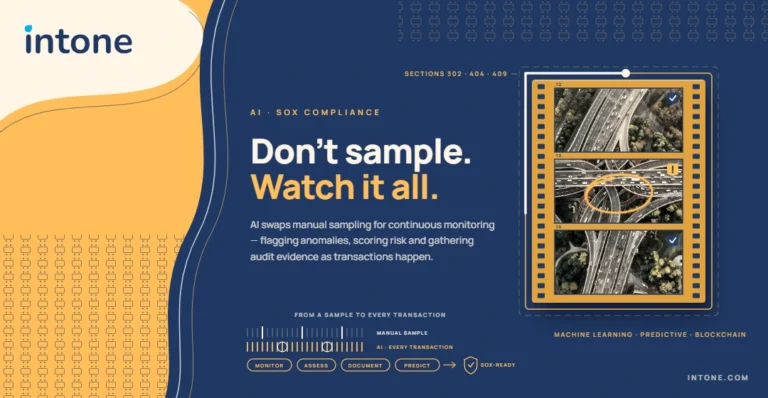
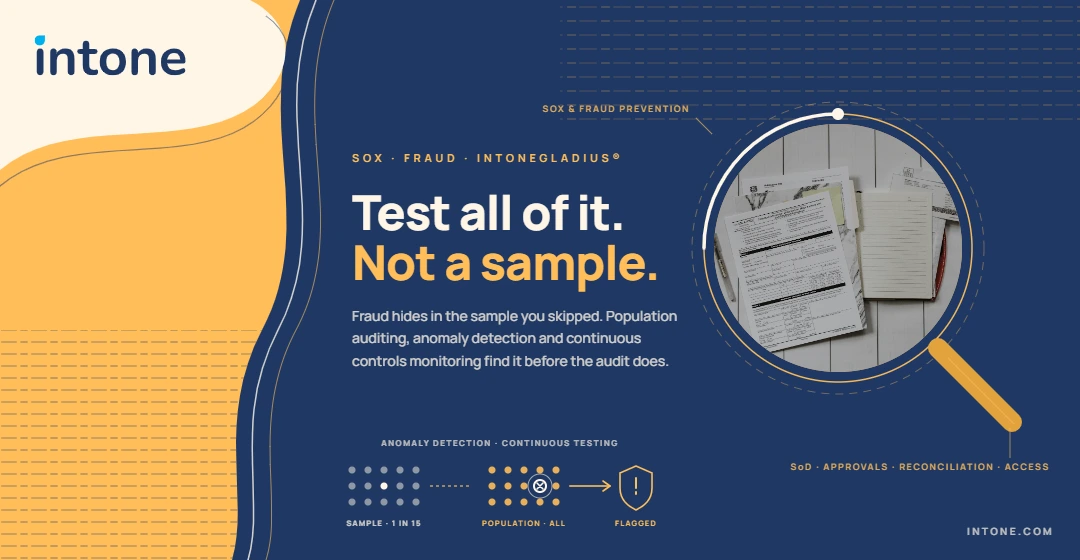
Instead of reviewing only a limited sample, population auditing can allow organizations to analyze larger or complete populations of transactions when the underlying data and technology support this approach.
Analyzing broader populations can increase the likelihood of identifying unusual patterns or exceptions that may not appear in a small sample.
Population-based analysis can therefore complement traditional control testing and strengthen fraud detection.
Anomaly Detection and Continuous Monitoring
Financial fraud does not always produce an obvious control failure. Suspicious activity may appear as unusual transaction patterns, unexpected changes in behavior, or activity that falls outside normal business processes.
Anomaly detection can help identify activity that differs from established patterns.
Continuous Controls Monitoring
Continuous controls monitoring uses technology to provide ongoing visibility into control activity and potential exceptions.
Rather than waiting for a scheduled audit or periodic review, organizations can monitor relevant activities on an ongoing basis. This can help compliance and internal audit teams identify potential problems earlier.
Continuous monitoring can support both SOX compliance and broader regulatory compliance monitoring by providing more current information about the organization’s control environment.
Audit Automation and Evidence Automation
SOX compliance often requires organizations to collect and maintain substantial amounts of documentation demonstrating that controls have been performed.
Manual evidence collection can create administrative burdens and make it difficult to maintain consistent documentation.
Automate Evidence Gathering
Organizations can automate evidence gathering for appropriate control activities by connecting compliance processes with relevant systems and data sources.
Automated evidence collection can reduce repetitive administrative work while creating a more consistent record of control performance.
Evidence automation can also support audit readiness by helping teams organize and retrieve documentation when needed.
Internal Audit Automation
Internal audit automation can extend these benefits beyond SOX testing.
Automated workflows can support testing, issue management, evidence collection, notifications, and reporting. This can allow internal audit teams to spend more time analyzing risks and investigating exceptions rather than performing repetitive administrative activities.
Audit Readiness and Regular Audits
SOX compliance should be maintained throughout the year rather than treated as a task that begins immediately before an external audit.
Organizations that continuously monitor controls and maintain supporting evidence can improve audit readiness and reduce the effort required to prepare for regular audits.
Continuous monitoring can also help identify control deficiencies before they become significant audit findings.
Executive Dashboards
Executive dashboards can provide leadership with a consolidated view of compliance status, control performance, open issues, and emerging risks.
For CFOs, CIOs, chief audit executives, and other leaders, centralized reporting can make it easier to understand whether the organization’s control environment is operating effectively.
Cybersecurity and Financial Fraud Risk
Financial fraud prevention increasingly overlaps with cybersecurity.
Unauthorized access to financial systems, compromised credentials, privilege abuse, and malicious activity can create opportunities for financial manipulation.
Privileged Activity Monitoring
Privileged activity monitoring can help organizations identify unusual activity performed by users with elevated system permissions.
Monitoring privileged users can be particularly important for systems containing sensitive financial information or supporting critical financial processes.
Organizations should combine cybersecurity controls with financial controls to address risks that cross traditional departmental boundaries.
Vendor Compliance Monitoring
Organizations often depend on third-party vendors for technology, financial services, data processing, and other critical activities.
Third-party weaknesses can therefore affect an organization’s own compliance and financial reporting environment.
Vendor compliance monitoring can help organizations maintain visibility into relevant third-party requirements, assessments, and control activities.
Where vendors support SOX-relevant processes, organizations should understand how those services affect their own internal control environment.
Regulatory Compliance Monitoring
SOX is only one component of a broader regulatory environment.
Organizations may need to address requirements related to financial reporting, privacy, cybersecurity, industry-specific regulations, and regional compliance obligations.
Regulatory compliance monitoring can help organizations maintain visibility into changing requirements and evaluate whether existing controls remain appropriate.
A centralized compliance approach can reduce the risk of managing regulatory obligations in isolated systems or spreadsheets.
The Role of GRC in Fraud Prevention
Governance, Risk, and Compliance (GRC) technology can connect controls, risks, compliance requirements, issues, evidence, and monitoring activities within a centralized environment.
A GRC platform can help organizations establish relationships between financial reporting risks and the controls designed to mitigate those risks.
GRC Advisory and Monitoring
Organizations developing a GRC program may benefit from GRC advisory services to determine which processes should be monitored, how controls should be structured, and where automation can provide the greatest value.
A structured GRC monitoring roadmap can help organizations move from periodic manual reviews toward more continuous, risk-based monitoring.
Automation as Part of Business Transformation
Automation is increasingly becoming part of broader business transformation initiatives.
Organizations modernizing legacy systems can use automation to reduce repetitive compliance work while improving visibility into operational and financial risks.
Legacy Modernization
Legacy modernization can also affect SOX compliance. When organizations migrate financial systems or change enterprise applications, they must consider how those changes affect existing controls, data flows, access rights, and reporting processes.
Control automation can help organizations maintain appropriate oversight as technology environments evolve.
Benefits of Integrating SOX Compliance and Fraud Prevention
Connecting SOX compliance activities with fraud prevention can provide several benefits:
- Earlier risk identification: Continuous monitoring can identify unusual activity and control exceptions more quickly.
- Improved control visibility: Centralized information can help management understand the status of key controls.
- Greater audit readiness: Automated evidence collection can simplify preparation for audits and assessments.
- Reduced manual effort: Automation can reduce repetitive testing and documentation activities.
- Stronger accountability: Clearly defined control ownership makes it easier to assign and track remediation.
- Better decision-making: Dashboards and centralized reporting can provide executives with more timely compliance information.
Why Choose IntoneGladius®?
Managing SOX compliance and fraud prevention across complex environments can become increasingly difficult as organizations adopt cloud platforms, distributed systems, and interconnected enterprise applications.
IntoneGladius® provides GRC capabilities designed to help organizations manage controls, risks, compliance requirements, and monitoring activities through a centralized platform.
The platform can support:
- Continuous controls monitoring
- Automated control testing
- Compliance and risk monitoring
- Centralized control management
- Automated evidence collection
- Real-time dashboards and reporting
- Risk and issue management
- Customizable workflows
- Compliance management across multiple frameworks
These capabilities can help organizations move from periodic, manually intensive compliance activities toward a more continuous and data-driven approach to SOX compliance, fraud prevention, and risk management.
For additional information, see Intone’s related resource, SOX Compliance and Financial Fraud Prevention.
Contact Intone to learn more about IntoneGladius® and strengthening your organization’s compliance and fraud prevention program.
Key Takeaways
- SOX compliance and financial fraud prevention are closely connected through internal controls.
- Effective control testing can help organizations identify weaknesses that may create opportunities for fraud.
- Continuous controls monitoring provides more frequent visibility into control performance.
- Anomaly detection and population auditing can help identify unusual activity.
- Automating evidence gathering can improve audit readiness and reduce manual work.
- Cybersecurity and privileged activity monitoring can complement traditional financial controls.
- Vendor and regulatory compliance monitoring can extend oversight beyond internal processes.
- GRC technology can centralize controls, risks, compliance requirements, and evidence.
- Automation can help organizations create a more scalable and proactive compliance environment.
FAQ’s
SOX compliance requires organizations to maintain effective internal controls over financial reporting. These controls can help prevent unauthorized activity, identify errors and anomalies, and provide greater oversight of financial processes.
Internal controls establish processes for authorization, access, review, reconciliation, and accountability. Strong controls can reduce opportunities for fraudulent activity and help organizations identify suspicious behavior.
Continuous controls monitoring provides ongoing visibility into control activity and potential exceptions. This can help organizations identify weaknesses sooner than periodic testing alone.
Yes. Automation can support control testing, evidence collection, monitoring, reporting, and issue management. This can reduce repetitive manual work and improve the consistency of compliance processes.
Audit readiness refers to an organization’s ability to demonstrate that relevant controls are appropriately designed, implemented, documented, and operating effectively when an audit or assessment occurs.
Organizations can use techniques such as:
- Anomaly detection
- Population auditing
- Transaction monitoring
- Access monitoring
- Continuous controls testing
To identify activity that differs from expected patterns.
Cybersecurity controls can help protect financial systems from unauthorized access, compromised credentials, and malicious activity. Combining cybersecurity monitoring with financial controls can provide broader protection against technology-enabled fraud.
IntoneGladius® provides GRC capabilities for control management, continuous monitoring, automated testing, evidence collection, risk management, and compliance reporting, helping organizations strengthen oversight and audit readiness.