

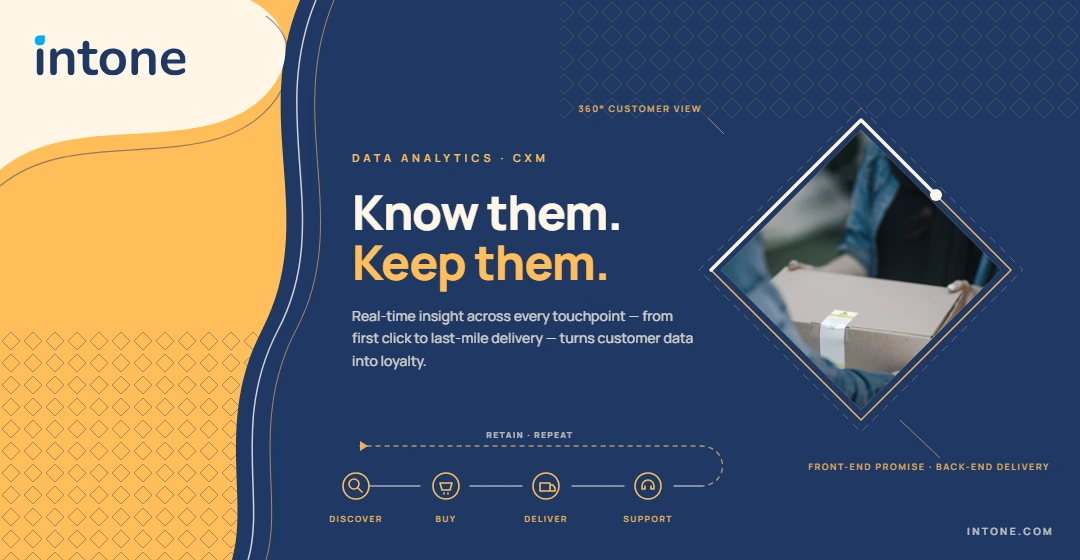
Why real-time customer insights, integrated supply chain management, and data-driven decision-making matter for long-term customer loyalty.
Understanding and optimizing Customer Experience Management (CXM) requires more than collecting data; it demands transforming raw customer interactions into practical insights across every touchpoint. Leveraging data analytics services enables enterprise organizations to achieve real-time personalization, predictive customer engagement, supply chain alignment, and higher operational efficiency to drive lasting customer satisfaction and brand retention.
Customer Experience Management (CXM) is adopted by businesses across every industry to oversee, measure, and elevate every customer interaction. The primary goal of CXM is to improve customer satisfaction and brand loyalty by understanding and influencing customer insights at every stage of the buyer’s journey—from initial brand discovery to ongoing post-purchase support.
By placing a sustained focus on customer experience, companies can stand out in an increasingly crowded market, ensure long-term retention, and promote scalable growth.
Leveraging specialized data analytics services is important in this process, as it allows organizations to analyze vast volumes of customer interactions, preferences, and operational touchpoints. This leads to better-informed decisions that directly improve the overall customer experience across every touchpoint.
In conversations with marketing, operations, and CX leaders, we hear a version of the same concern time and again:
“Our teams collect massive volumes of customer data, but our operations struggle to deliver personalized experiences and reliable fulfillment in real time. What design changes are required to achieve true CXM transformation?”
It is a fair question—and one that reveals a common misconception about modern CXM. In many cases, the issue is not whether an organization collects customer data. It is whether the organization can translate raw behavioral streams into practical insights that optimize customer engagement while maintaining seamless operational execution. [Text Wrapping Break][Text Wrapping Break]What Are Data Analytics Services?
Data analytics services help organizations collect, process, analyze, and interpret data to generate actionable business insights. They use techniques such as data visualization, statistical analysis, and predictive analytics to identify trends, improve decision-making, and optimize business performance.
The CXM Analytics Paradox
Many organizations begin their Customer Experience Management journey expecting customer retention and sales conversions to surge simply by implementing basic tracking tools.
From an operational perspective, that expectation makes sense. Standard tracking tools record transactions, monitor web visits, and digitize customer feedback.
However, data collection alone does not automatically translate into customer loyalty or operational efficiency.
CX leaders are not simply evaluating whether data is captured. They are assessing whether the insights derived from that data are actionable, accurate, timely, and capable of improving real-world customer interactions.
As a result, many organizations encounter a significant barrier to achieving a true 360-degree customer view. The issue is rarely whether data exists; it is whether the organization can demonstrate how to turn data into a smarter business decision that enhances satisfaction across every touchpoint.
When that connection is missing, teams suffer from disconnected messaging, fulfillment delays, and fragmented customer journeys, reducing many of analytics’ expected benefits. [Text Wrapping Break]Common challenges such as data silos, poor data quality, and disconnected systems can make it difficult to turn customer data into reliable insights. When information is scattered across different platforms or contains inconsistencies, organizations may struggle to create a complete view of the customer and make timely, informed decisions. Addressing these challenges is essential for analytics to deliver meaningful improvements in customer experience.
Real-Time Examples of Data Analytics in CXM
Understanding customer needs and preferences is essential for effective CXM. By understanding what customers truly value, businesses can adjust their products, services, and communication styles to meet evolving expectations. This directly boosts overall customer satisfaction, promotes customer retention, and encourages long-term brand loyalty. Modern studies consistently show that customers stay loyal to brands that offer tailored, personalized experiences, making a deep understanding of your target audience indispensable.
To better understand how data analytics is impacting CXM in practice, consider these real-world implementations:
- J.P. Morgan Payments: In recent developments, financial institutions and enterprises are increasingly leveraging modern analytics tools to enhance CXM. A notable example is J.P. Morgan Payments’ Customer Insights Solution, which analyzes underlying transaction data to provide actionable strategies for businesses. This tool helps companies understand exactly when and where customers prefer to purchase—whether in-store or online—enabling tailored marketing efforts that boost sales and customer loyalty. [Text Wrapping Break]Source: J.P. Morgan Payments – Unlock Customer Insights for Better Business Decisions
- Tesco Clubcard: In 2024, retail giant Tesco used AI and data from its Clubcard loyalty program to offer hyper-personalized product recommendations and customized incentives through Clubcard challenges. This helped customers quickly find relevant products, encouraged repeat purchases, and significantly improved their overall shopping experiences. [Text Wrapping Break]Source: https://www.tesco.com/For a deeper dive into these real-world applications, explore our detailed analysis on how data analytics is impacting Customer Experience Management.
Definition and Core Types of Data Analytics
A robust data analytics framework involves the systematic computational analysis of data sets to uncover hidden patterns, trends, and practical insights. To build a mature CXM strategy, businesses rely on three primary types of data analytics:
1. Descriptive Analytics: Focuses on summarizing historical data to understand what has already happened in past customer interactions or operational cycles.
2. Predictive Analytics: Uses statistical models, historical baselines, and machine learning techniques to forecast future outcomes and customer behaviors.
3. Prescriptive Analytics: Provides concrete recommendations for action based on predictive insights to optimize strategic planning and automated workflows.
Mastering these analytical models yields significant benefits of data analytics, turning legacy feedback loops into continuous growth engines.
The Critical Importance of Real-Time Data in CXM
Real-time data is important for effective CXM because it gives businesses the agility to respond promptly to customer needs, friction points, and preferences as they happen. By analyzing streaming data feeds, companies can identify emerging trends immediately, allowing them to adjust active campaigns or service protocols without delay.
Personalization Through Customer Segmentation
Customer segmentation involves dividing a broader audience into distinct groups based on common characteristics, purchasing histories, or behavioral patterns. This process allows businesses to personalize marketing approaches, product recommendations, and digital communications, creating far more relevant experiences for each unique segment.
Using Predictive Analytics to Anticipate Customer Needs
Predictive analytics acts as a proactive driver for customer engagement. By analyzing historical behavior, businesses can identify indicators that signal future intent, allowing support or sales teams to address potential issues or offer specialized solutions before the customer even asks.
Building a 360-Degree Customer View Using Data Integration
Creating a comprehensive view of the customer involves integrating disparate data streams from CRMs, e-commerce platforms, and customer support channels into a single, unified source of truth. This 360-degree view enables organizations to understand the complete customer journey, facilitating better strategic alignment and personalized interactions.
Enhancing CXM Across the Supply Chain
While front-end customer interfaces get most of the attention in CXM, true customer satisfaction is deeply tied to back-end execution. Friction in delivery timelines, stock availability, or order fulfillment directly damages the customer experience.
Aligning Supply Chain Efficiency with Customer Expectations
Integrating supply chain data with customer experience platforms ensures that customer promises match operational reality. When customer demand surges, real-time analytics across the logistics network allow businesses to adjust inventory distribution dynamically, keeping fulfillment promises intact.
Data-Driven Supply Chain Management for Frictionless Fulfillment
Modern supply chain management relies on predictive analytics to forecast demand spikes, optimize inventory levels, and reduce shipping delays. By leveraging analytics across your supply chain, you prevent stockouts and shipping bottlenecks—directly protecting the customer experience and driving higher retention rates.
Real-Time Decision-Making and Responsiveness
Speed and relevance are central to modern CXM. Utilizing data for real-time decision-making transforms passive customer service into active, value-adding engagement.
- Leveraging Data for Real-Time Customer Engagement: Using real-time interaction data allows companies to connect with customers at critical decision-making junctures, boosting conversion rates and satisfaction.
- Chatbots and AI-Powered Recommendations: Implementing AI-powered chatbots provides immediate, 24/7 assistance while recommending products based on a customer’s real-time browsing history and past purchases.
- Dynamic Pricing and Promotional Offers Based on Analytics: Data analytics services inform dynamic pricing strategies by analyzing real-time market trends, inventory levels, and consumer demand, allowing businesses to launch timely promotions that meet market demand.
Driving Better Customer Retention and Loyalty
Acquiring a new customer costs significantly more than retaining an existing one. CXM strategies powered by analytics offer direct tools to maximize long-term retention.
Identifying At-Risk Customers Using Churn Analysis
Churn analysis tracks behavioral red flags—such as declining login frequency, reduced purchasing volume, or unresolved support tickets—to flag accounts at risk of leaving. Armed with these insights, teams can execute targeted win-back campaigns to re-engage customers before they defect.
Tailored Loyalty Programs Informed by Data Insights
Data-driven loyalty programs ensure that rewards and incentives align with what individual customer segments value most. This personalized approach transforms generic rewards programs into meaningful touchpoints that deepen brand loyalty.
Measuring Customer Lifetime Value (CLV)
Measuring CLV helps organizations evaluate the long-term economic value each customer segment brings to the business. By analyzing purchasing patterns, average order value, and engagement frequency, companies can optimize acquisition spend and focus retention resources on high-value segments.
Essential Metrics for Measuring CXM Impact
To assess whether your CXM initiatives are driving meaningful outcomes, regularly track these core metrics:
- Net Promoter Score (NPS): Measures overall brand advocacy and loyalty by assessing how likely customers are to recommend your business to others.
- Customer Satisfaction Score (CSAT): Evaluates short-term satisfaction immediately following specific transactions, interactions, or support requests.
- Customer Effort Score (CES): Measures how easy or difficult it was for a customer to complete an action, resolve an issue, or interact with your digital platforms.
Prioritizing Privacy and Security Topics in CXM
As organizations collect and analyze deeper customer datasets, maintaining strict data compliance, robust encryption, and transparent privacy controls becomes non-negotiable. Addressing data security topics protects customer trust and ensures regulatory compliance. Compliance frameworks such as the General Data Protection Regulation (GDPR) and the California Consumer Privacy Act (CCPA) provide important guidelines for protecting customer data and strengthening privacy practices. Prioritizing security ensures that customers feel safe sharing their preferences, creating a secure foundation for personalized analytics.
Best Practices for Improving CXM with Data Analytics Services
To get the highest return on investment from your analytics infrastructure, adopt these fundamental best practices:
1. Invest in Data Integration for a Unified Customer View
Combine customer data across CRM systems, web analytics, social channels, and transactional platforms to eliminate data silos and construct actionable profiles.
2. Use Sentiment Analysis for Unstructured Feedback
Deploy natural language processing (NLP) tools to analyze online reviews, social media mentions, and survey comments to gauge underlying customer emotions and sentiment.
3. Automate Customer Journey Mapping
Continuously track end-to-end customer journeys using automated analytics tools to highlight friction points and drop-off steps.
4. Synchronize CX Insights with Supply Chain Management
Link real-time demand forecasts directly to fulfillment workflows within supply chain management to ensure product availability and reliable delivery timelines.
5. Prioritize Governance and Security Topics
Maintain rigorous cybersecurity standards and regulatory compliance monitoring across all customer analytics platforms.
6. Monitor CX Metrics Regularly
Continuously track NPS, CSAT, CES, and churn metrics against baseline benchmarks to iterate and refine your engagement strategies over time.
Why Intone’s Data Analytics Services Change the Conversation
Many organizations view basic reporting dashboards as the finish line. In reality, tracking data is only one part of the equation. The greater challenge is creating an operational ecosystem where insights actively drive decision-making across both customer-facing channels and back-end fulfillment networks.
Intone brings deep domain expertise in data analytics services, delivering tailored digital solutions that streamline operations, elevate customer journeys, and improve operational efficiency. Rather than presenting isolated reports, Intone helps organizations connect customer interactions directly to actionable business outcomes.
That distinction matters.
When teams can act on unified, real-time insights, they deliver consistent satisfaction and drive measurable growth. IntoneSwift® can support this approach by connecting enterprise data sources and helping organizations manage integrated data environments.
The Future of CXM Is Data-Driven Trust
The conversation around Customer Experience Management is changing. Not long ago, success was measured simply by the volume of customer data an organization could collect.
Today, a more meaningful question is emerging:
Will those analytics actually lead to a better business decision and higher customer retention?
The organizations realizing the greatest return on CXM investments are not necessarily collecting the most data. They are creating environments where data is transparent, actionable, and integrated across both marketing and supply chain management.
Data collection reduces ambiguity.
Actionable analytics drives operational efficiency and revenue growth.
The difference lies in the quality of the insights.
Organizations that prioritize real-time personalization, practical insights, supply chain alignment, and customer trust are better positioned to maximize customer lifetime value and stay ahead of the competition.
Key Benefits of Data Analytics in Modern CXM
Implementing a modern data analytics architecture offers wide-ranging, enterprise-wide advantages that go far beyond basic reporting:
- Enhanced Operational Efficiency: Automating data aggregation and reporting streamlines internal processes, allowing customer-facing teams to focus on high-value problem solving.
- Faster, Smarter Business Decision Making: Moving from gut-feel planning to data-backed strategy ensures every business decision is backed by real-world behavioral trends and statistical evidence.
- Actionable Practical Insights: Transforming raw interaction logs into practical insights empowers product, sales, and support teams to take immediate, high-impact actions.
- Higher Customer Retention and Revenue: Tailoring experiences directly to verified preferences yields higher customer lifetime value, lower churn, and predictable revenue growth.
FAQ’s
Data analytics allows businesses to convert raw interaction data into practical insights, enabling personalized marketing, predictive support, dynamic pricing, and faster response times across all touchpoints.
A well-managed supply chain ensures that advertised products remain in stock and order fulfillment is fast and reliable. Integrating CX insights with supply chain management prevents inventory shortages and shipping delays, directly boosting customer satisfaction.
Analytics helps identify churn risks early through predictive behavior modeling, enables tailored loyalty rewards, and allows companies to calculate and optimize Customer Lifetime Value (CLV).
Addressing security topics—such as data encryption, privacy compliance, and transparent governance—ensures customer data is safeguarded, making consumers far more willing to share preferences for personalized experiences.
Intone’s data analytics services help organizations connect customer data with actionable insights, streamline operations, and improve customer journeys. IntoneSwift® supports this by connecting enterprise data sources and managing integrated data environments.