

Discover how effective data management in the insurance industry can improve operational efficiency, data accuracy, compliance, decision-making, and customer experiences.
Data management in the insurance industry is the systematic collection, organization, integration, storage, processing, and analysis of data generated throughout insurance operations. Effective data management helps insurers improve data accuracy, streamline data operations, strengthen compliance, enhance customer experiences, and make more informed business decisions.
In an increasingly data-driven insurance industry, organizations generate and process enormous volumes of information every day. Policyholder records, claims information, underwriting data, financial transactions, market trends, and customer interactions all contribute to the growing volume and complexity of insurance data.
Managing this information effectively is essential for insurers seeking to improve operational efficiency, data accuracy, customer experiences, and regulatory compliance.
Data management is no longer simply a technology function. It is a strategic business capability that influences how quickly organizations can make decisions, identify risks, serve customers, and respond to changes across the insurance industry.
For enterprise leaders, the challenge is not simply collecting more information. It is ensuring that data remains accurate, accessible, secure, and relevant throughout its lifecycle.
Common Insurance Data Sources
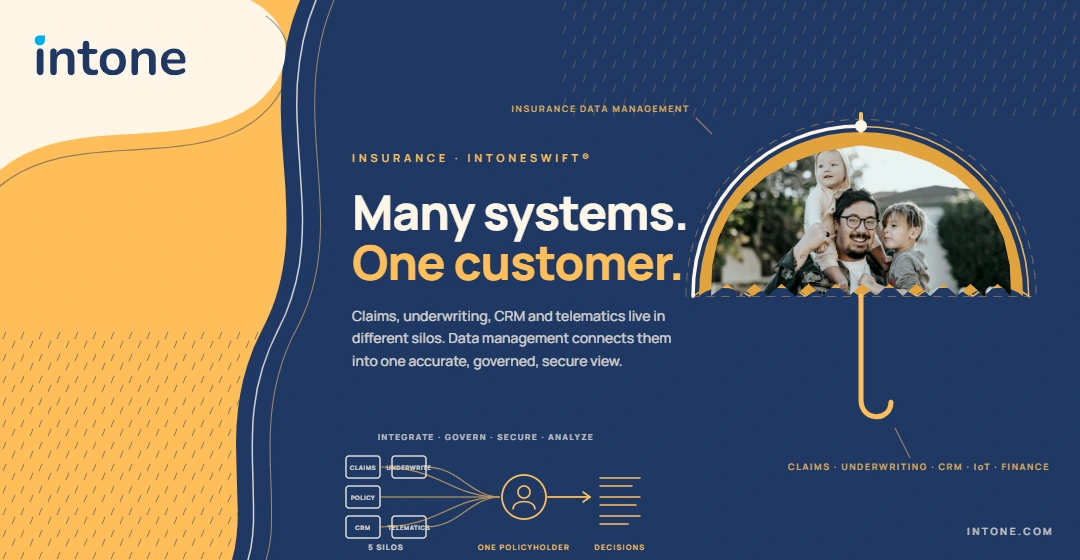
Insurance organizations collect data from a variety of internal systems and external sources. Common insurance data sources include:
- Claims data: Claim submissions, loss information, settlement records, and claims history.
- Underwriting data: Risk assessments, applicant information, coverage details, and underwriting decisions.
- Policyholder data: Customer profiles, policy information, contact details, and coverage history.
- CRM data: Customer interactions, service requests, communications, and engagement history.
- IoT and telematics data: Data from connected devices, sensors, and telematics systems, such as vehicle usage, driving behavior, and other real-time measurements.
Data Management in the Insurance Industry
Data management in the insurance industry involves the systematic and strategic handling of the information insurers generate, collect, store, process, integrate, and analyze.
This includes information related to:
- Policyholders and customers
- Insurance policies
- Claims and loss information
- Underwriting
- Financial transactions
- Risk assessments
- Market trends
- Customer interactions
- Regulatory reporting
An effective data management strategy establishes processes for maintaining data quality and making information accessible to the people and systems that need it.
When data is fragmented across disconnected applications, spreadsheets, databases, and legacy systems, employees may struggle to access a consistent view of important information.
By contrast, well-managed data can help insurers create more efficient workflows, improve collaboration, and support better business decision-making.
Why Data Management Matters in the Insurance Industry
The importance of data management continues to grow as insurers adopt new technologies and become increasingly dependent on data-driven processes.
Managing the Growing Volume of Insurance Data
Insurance organizations process substantial amounts of information across underwriting, claims, customer service, finance, and other business functions.
Without appropriate data management practices, large volumes of information can become difficult to organize and maintain. Duplicate records, incomplete information, inconsistent formats, and disconnected systems can reduce the usefulness of data.
A structured approach to data management helps insurers maintain information that is easier to access, understand, and analyze.
Improving Data Accuracy
Data accuracy is essential when decisions depend on information being reliable and current.
Inaccurate policyholder information, incorrect claims data, or inconsistent financial records can affect downstream processes and potentially lead to poor decisions.
Data validation, cleansing, standardization, and governance can help organizations identify and address data-quality issues before they affect critical processes.
Improving Operational Efficiency
Effective data management can improve operational efficiency by reducing the time employees spend searching for information, reconciling inconsistent records, or manually transferring data between systems.
Centralized and well-integrated data environments can allow employees to access relevant information more quickly.
This can benefit processes such as underwriting, claims processing, customer service, reporting, and risk assessment.
Data Integration and Data Operations
Insurance organizations frequently rely on multiple applications and platforms. These systems may contain valuable information but may not always communicate effectively with one another.
Connecting Disconnected Data Sources
Data integrations allow information to move between systems so that it can be accessed and used across different business processes.
For example, information from a customer relationship management platform may need to interact with policy administration, claims, analytics, or financial systems.
Without effective integration, employees may have to manually move information between platforms, increasing the possibility of errors and delays.
Streamlining Data Operations
Efficient data operations help organizations manage the movement, processing, transformation, and availability of information across their technology environment.
Automation can reduce repetitive data-processing tasks while improving consistency and scalability.
For insurers managing large and complex data environments, streamlined data operations can help support faster business processes and more reliable information.
Data Optimization and Better Business Decisions
Collecting large amounts of data does not automatically create business value. Organizations need to ensure that data is relevant, accessible, accurate, and usable.
The Relevance of Data Optimization
The relevance of data optimization lies in turning existing information into something that can actively support business objectives.
Data optimization may involve improving data quality, removing unnecessary duplication, standardizing information, improving integrations, and making data easier to access.
When data is optimized effectively, insurers can spend less time resolving data problems and more time using information to support strategic decisions.
Supporting Data-Driven Decision-Making
Reliable information allows insurers to make more informed decisions across underwriting, claims, pricing, customer service, and risk management.
Data analytics can help organizations identify patterns and trends that may not be immediately apparent from individual records.
For example, insurers can use analytics to evaluate claims trends, understand customer behavior, identify potential risks, and assess changing market conditions.
The quality of these insights ultimately depends on the quality of the underlying data.
Data Governance and Compliance
Insurance companies operate in a highly regulated environment and often manage sensitive customer information.
Strong data governance establishes policies, responsibilities, standards, and processes for managing data throughout the organization.
Supporting Compliance
Data management practices can help insurers maintain compliance with applicable regulatory and industry requirements.
Organizations may need to demonstrate that sensitive information is appropriately protected, that data is accurate, and that relevant records can be accessed when required.
Effective compliance monitoring can provide greater visibility into whether relevant policies and controls are operating as expected.
Protecting Sensitive Information
Insurance organizations handle sensitive personal, financial, and health-related information. Protecting this information is therefore a critical component of effective data management.
Organizations should consider controls such as encryption, access management, authentication, monitoring, and secure data storage.
Data governance and security practices should work together to protect information throughout its lifecycle.
Cybersecurity and Insurance Data
The growing volume of digital information also increases the importance of cybersecurity.
Insurance organizations can be attractive targets for cyber attacks because they maintain extensive customer and financial information.
Cybersecurity Monitoring
Cybersecurity monitoring can help organizations identify suspicious activity, unauthorized access, and other potential security risks.
Data management environments should therefore be designed with security considerations built into their architecture and processes.
Organizations can strengthen their overall data protection strategy by combining secure data practices with appropriate access controls, monitoring, risk management, and incident response capabilities.
Technology and Data Management
Technology is playing an increasingly important role in how insurers collect, integrate, process, and analyze information.
Artificial intelligence, machine learning, automation, cloud platforms, and advanced analytics can help organizations extract greater value from their data.
Using Analytics to Improve Insurance Operations
Data analytics can support a range of insurance activities, including:
- Underwriting: analyzing information to support risk assessment
- Claims: identifying trends and potential anomalies
- Customer experience: understanding customer behavior and preferences
- Risk management: identifying emerging risks and patterns
- Operations: identifying opportunities to improve processes
- Planning: supporting more informed strategic decisions
Technology can therefore help transform data from a passive organizational resource into an active business capability.
Continuous Controls Monitoring and Data Governance
As insurers become more dependent on interconnected systems and automated processes, maintaining visibility into data and controls becomes increasingly important.
Continuous controls monitoring can provide organizations with ongoing visibility into relevant control activity and potential exceptions.
Rather than relying entirely on periodic reviews, organizations can use technology to monitor activities more consistently and identify issues closer to when they occur.
This approach can complement data governance and compliance programs by helping organizations maintain greater visibility into their operational environment.
Data Management for Enterprise Leaders
For enterprise leaders, effective data management should be viewed as a long-term business priority rather than an isolated technology initiative.
A successful data strategy requires collaboration across technology, operations, finance, compliance, risk, and business teams.
Leaders should consider:
- What data is critical to the organization?
- Where is that data stored?
- How does information move between systems?
- Who owns and manages important data?
- How is data quality measured?
- How is sensitive information protected?
- How can data support better business decisions?
Answering these questions can help organizations develop a more coordinated approach to data management.
Building Organizational Readiness
As insurance companies modernize their technology environments, they should consider how new systems and integrations will affect existing data processes.
Effective planning can help organizations avoid creating additional data silos while improving scalability and long-term operational efficiency.
Practical Insights for Insurance Data Management
Organizations looking to improve their data management strategy can begin with several practical steps.
Establish Data Governance
Define ownership, standards, policies, and responsibilities for critical data.
Improve Data Quality
Regularly identify duplicate, incomplete, inconsistent, or outdated information and establish processes for correcting it.
Integrate Disconnected Systems
Connect relevant data sources so employees and applications can access consistent information without unnecessary manual transfers.
Automate Repetitive Data Operations
Automation can reduce manual data-processing activities and help employees focus on higher-value analytical and operational work.
Monitor Data and Controls
Ongoing monitoring can provide greater visibility into data processes, security risks, compliance requirements, and control performance.
Align Data Strategy With Business Goals
Data management initiatives should support measurable business outcomes such as improved efficiency, better customer experiences, stronger risk management, and more informed decision-making.
Why Choose IntoneSwift®?
Effective data management requires more than storing information in a central location. Insurance organizations need technology that can connect disparate systems, process information efficiently, maintain data visibility, and support data-driven operations.
IntoneSwift® is designed to help organizations manage complex data environments through integration, processing, optimization, and monitoring capabilities.
The platform provides capabilities including:
- Knowledge graph for data integrations
- 1,000+ data, application, and device connectors
- Graphical no-code/low-code capabilities
- Distributed in-memory data operations
- Attribute-level data lineage
- Data encryption
- Centralized password and connection management
- Real-time, streaming, and batch data processing
- Support for heterogeneous data sources
- Real-time monitoring and updates
These capabilities can help insurers reduce data silos, streamline data operations, improve data accessibility, and create a more connected data environment.
For additional insights, see Intone’s related resource on Optimizing Operations Through Effective Data Management in Insurance.
Contact Intone to learn more about IntoneSwift® and how effective data management can support your insurance organization.
Key Takeaways
- Data management is a strategic capability for the insurance industry, not simply a technology function.
- Accurate and accessible data can improve operational efficiency and business decision-making.
- Data integrations can connect disconnected systems and reduce manual data movement.
- Data optimization can improve the quality, accessibility, and usefulness of organizational information.
- Strong data governance can support compliance and responsible data management.
- Cybersecurity and cybersecurity monitoring are essential when managing sensitive insurance information.
- Data analytics can help insurers identify patterns, assess risks, and improve customer experiences.
- Continuous controls monitoring can provide greater visibility into control and compliance activities.
- A coordinated data strategy can help enterprise leaders support long-term operational and technological goals.
- IntoneSwift® provides data integration, processing, lineage, encryption, and monitoring capabilities for complex data environments.
FAQ’s
Data management helps insurers organize and maintain large volumes of customer, policy, claims, financial, and market information. Effective data management can improve accuracy, operational efficiency, compliance, and decision-making.
It can reduce data silos, streamline data operations, automate repetitive processes, improve access to information, and help employees work with more consistent and accurate data.
Data optimization involves improving the quality, accessibility, integration, and usability of data so that organizations can extract greater value from their information and support better business decisions.
Data integration connects information across applications and systems. This can reduce manual data transfers, improve information consistency, and provide employees with a more complete view of relevant business information.
Insurance companies manage sensitive personal, financial, and other information. Strong cybersecurity controls help protect this information against unauthorized access, malicious activity, and other potential threats.
Data analytics can help insurers identify trends, evaluate risks, understand customer behavior, analyze claims, support underwriting, and make more informed operational and strategic decisions.
Continuous controls monitoring uses technology to provide ongoing visibility into control activity and potential exceptions. It can complement data governance and compliance monitoring by helping organizations identify issues more quickly.
IntoneSwift® provides data integration, processing, lineage, encryption, monitoring, and data operations capabilities designed to help organizations connect and manage complex data environments.