

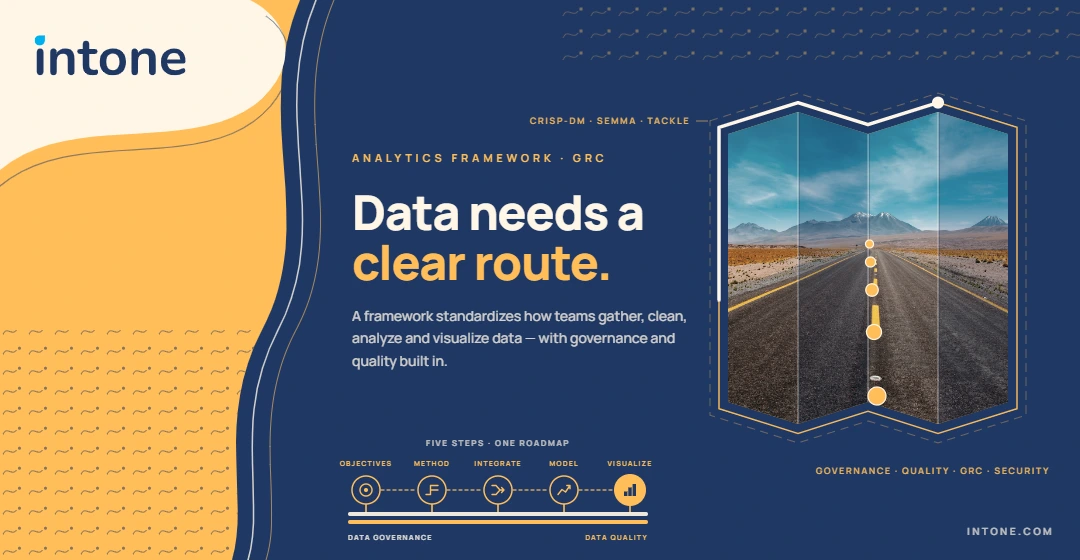
In today’s fast-paced digital economy, organizations generate vast amounts of raw data every second. However, raw data alone does not create business value. To turn complex datasets into actionable business intelligence, organizations require a structured approach. A Data Analytics Framework is a systematically designed methodology for analyzing data, providing a clear roadmap to extract valuable insights from initial collection to final visualization. By adopting an effective data strategy, enterprise leaders can make confident, business decision choices, streamline processing, optimize operations, and secure long-term business success.
What is a Data Analytics Framework?
A Data Analytics Framework serves as the structural foundation for an enterprise’s entire data journey. It standardizes how teams gather, clean, process, analyze, and visualize information. Without a coherent framework, data initiatives often suffer from fragmented management, inconsistent metrics, and misaligned business priorities.
Building a formalized framework ensures that every analytical model directly supports core business objectives. Whether your goal is improving customer retention, enhancing compliance, or refining operational workflows, a structured framework converts disparate data into practical insights.
Why Enterprise Leaders Need Data Governance and Quality Controls
To maximize the yield of analytics initiatives, data cannot exist in a vacuum. It must be protected, organized, and validated through rigorous oversight.
- Data Governance (Policy & Control) sets the rules, compliance standards, and ownership structure for enterprise data.
- Data Quality (Accuracy & Trust) ensures that the data being governed remains clean, reliable, and consistent.
- Effective Analytics & Business Value is the ultimate output—realized only when robust governance and high data quality work together.
Establishing Data Governance Across the Organization
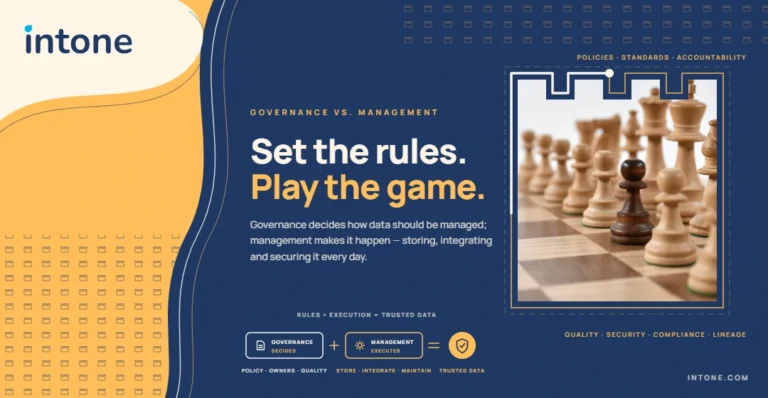
Implementing strong Data Governance guarantees that data across all business units remains secure, consistent, and compliant with regulatory mandates. Data Governance defines ownership, access controls, and ethical usage standards for corporate data assets.
Enterprise leaders often confuse governance with routine operational handling. To understand how operational execution works with strategic supervision, review our detailed guide on – Data Governance for Regulatory Compliance: Essentials Enterprise Strategy.
Turn complex data assets into clear growth.
Maintaining High Data Quality for Reliable Outcomes
An analytics framework is only as good as the underlying data. Prioritizing data quality prevents flawed inputs from skewing strategic decisions. High-quality data must be:
- Accurate: Free from errors, duplications, and noise.
- Consistent: Uniformly formatted across disparate databases and business units.
- Timely: Updated regularly to support real-time analysis and operational needs.
- Accessible: Available to authorized personnel while maintaining strict security controls.
Core Pillars for Building an Effective Data Analytics Framework
Building an enterprise framework requires a methodical approach that aligns technical execution with overarching strategic goals.
- Step 1: Define Business Objectives & Scope – Identify clear business questions, success metrics, and project constraints before diving into data.
- Step 2: Select the Optimal Analytical Methodology – Determine the right statistical, predictive, or prescriptive modeling techniques required for the problem.
- Step 3: Execute Data Integration & Ingestion – Gather, centralize, and streamline continuous data streams into the system architecture.
- Step 4: Preprocess, Clean, and Apply Analytics Models – Handle missing values, eliminate noise, engineer features, and train the analytical engines.
- Step 5: Visualize, Communicate, and Iterate – Translate technical results into clear visual stories, share findings with stakeholders, and continuously refine the pipeline.
1. Define Business Objectives and Scope
Every successful analytics endeavor begins with strategic clarity. Enterprise leaders must clearly outline their goals before touching a single row of data.
- Are you aiming to reduce churn rate in enterprise accounts?
- Do you need to optimize supply chain workflows to reduce overhead?
- Are you seeking deeper valuable insights to refine target marketing campaigns?
Setting specific, measurable objectives acts as your strategic destination, ensuring that analytical efforts address genuine business needs.
2. Choose the Right Framework Methodology
Different business challenges demand different analytical methodologies. Choosing the right structural model aligns your operational process with organizational needs:
- CRISP-DM (Cross-Industry Standard Process for Data Mining): A proven six-phase framework covering business understanding, data understanding, data preparation, modeling, evaluation, and deployment.
- SEMMA (Sample, Explore, Modify, Model, Assess): Focuses heavily on the statistical and exploratory aspects of data manipulation, making it ideal for targeted machine learning initiatives.
- TACKLE (Target, Analyze, Collaborate, Knowledge, Learn, Evaluate): Emphasizes cross-functional collaboration and rapid iteration across multi-disciplinary teams.
3. Ensure Robust Data Integration and Data Storage
Modern enterprise applications pull information from legacy databases, cloud platforms, CRM applications, and third-party APIs. Establishing strong data integration pipelines guarantees seamless flow between raw sources and central data warehouses. Proper architecture planning for data storage ensures scalability while controlling infrastructure costs.
4. Preprocess Data and Apply Predictive Analytics
Raw data is rarely ready for analysis. The preprocessing phase handles missing values, removes statistical outliers, and standardizes data formats.
Once prepared, technical teams apply advanced modeling techniques—ranging from foundational statistical evaluations to sophisticated predictive analytics. These predictive models allow enterprises to anticipate market trends, forecast consumer behavior, and mitigate operational risks before they surface.
5. Visualize Findings and Communicate Results
Complex mathematical models hold little value if stakeholders cannot understand them. Data visualization tools translate massive datasets into intuitive graphs, heat maps, and executive dashboards. Clear visual storytelling enables leadership to evaluate progress, refine strategies, and take rapid action.
The Role of GRC Advisory and Security Topics in Modern Analytics
As organizations scale their data initiatives, exposure to regulatory, financial, and operational risk increases. Integrating governance, risk, and compliance into your framework protects both institutional reputation and infrastructure.
| Pillar / Mechanism | Function & Core Responsibility | Interconnection |
| Compliance Management | Defines regulatory standards, policies, and industry frameworks (e.g., GDPR, HIPAA, SOC 2). | Drives Security & Access Controls to enforce compliant operations. |
| Security & Access Controls | Implements authentication, role-based permissions (RBAC), and data protection mechanisms. | Feeds into Audit Trails & Integrity Verification for continuous monitoring. |
| Audit Trails & Integrity Verification | Tracks user actions, logs system events, and validates data authenticity. | Triggers and validates Risk Mitigation actions. |
| Risk Mitigation | Identifies vulnerabilities, resolves compliance gaps, and neutralizes security threats. | Completes the shield by reinforcing overall security and compliance postures. |
Aligning Analytics with GRC Advisory Standards
Partnering with specialized GRC advisory experts ensures your data pipelines align with global regulatory frameworks such as SOX, HIPAA, and GDPR. A robust GRC strategy embeds oversight directly into the analytical process, establishing clear internal controls and audit logging for sensitive data queries.
Addressing Enterprise Security Topics
Data security must be embedded into every phase of the analytics pipeline. Vital security practices include:
- Enforcing strict role-based access controls across data storage environments.
- Implementing end-to-end encryption for data both in transit and at rest.
- Conducting continuous vulnerability assessments across data integration nodes.
- Monitoring real-time usage log metrics to detect unauthorized access attempts.
Future Trends: Evolution of Data Analytics Frameworks
The modern data landscape shifts rapidly, driven by technological breakthroughs and expanding enterprise requirements.
| Trend | Domain / Focus | Core Capability & Strategic Value |
| Modular Architecture & Scalable Data Mesh | Infrastructure | Shifts from monolithic architectures to domain-driven, decentralized data ownership. |
| Automated Prep & AI Cleaning | Operations | Uses machine learning to detect anomalies, standardizing clean data pipelines automatically. |
| Democratized Self-Service Platforms | Enablement | Uses low-code interfaces to allow non-technical business teams to analyze data independently. |
| Edge Computing & Real-Time Processing | Execution | Moves data processing closer to the source to enable low-latency, real-time decision-making. |
AI-Driven Automation and Modular Architecture
Future frameworks are moving away from monolithic designs toward flexible, modular architectures. Organizations can select and reconfigure specific pipelines as operational requirements shift. Concurrently, machine learning models automate labor-intensive preparation tasks, such as outlier detection and schema mapping.
Democratization of Analytics and Real-Time Processing
Modern enterprise platforms increasingly feature low-code and no-code interfaces, enabling non-technical business leaders to extract key insights independently. Furthermore, the combination of edge computing and streaming analytics allows businesses to process high-volume events in real time, shifting decision-making from reactive reporting to proactive execution.
Strategic Value Realization
Building a resilient data analytics framework converts overwhelming volume into structured strategic leverage. By uniting governance, technical precision, and clear organizational alignment, enterprise leaders establish a repeatable engine for sustained growth and continuous innovation.
Need better data analytics governance?
Empower enterprise leaders with scalable data quality and GRC advisory solutions today.
Empower your organization with high-quality datasets, modern services, and continuous oversight to ensure long-term operational resilience in a data-driven world.
FAQ’s
A Data Analytics Framework is a standardized, systematic methodology that governs how an organization gathers, cleans, processes, analyzes, and visualizes data. Without a structured framework, analytics initiatives suffer from fragmented management, inconsistent metrics, and misaligned business priorities. Implementing a framework ensures that all analytical models directly support core enterprise objectives—such as improving retention, optimizing workflows, or enhancing compliance.
Data Governance and Data Quality are interdependent pillars of a reliable analytics strategy:
- Data Governance defines ownership, regulatory policy, ethical usage, and role-based access controls across the organization.
- Data Quality ensures the underlying data being governed remains accurate, consistent across systems, timely, and secure.
Governance provides the oversight rules, while data quality ensures the inputs are reliable. For a deeper breakdown on strategic supervision, refer to our detailed guide: [Data Governance for Regulatory Compliance: Essentials Enterprise Strategy].
Depending on organizational goals and technical requirements, enterprise leaders typically choose from three core structural models:
- CRISP-DM (Cross-Industry Standard Process for Data Mining): A six-phase model (Business Understanding, Data Understanding, Data Preparation, Modeling, Evaluation, and Deployment) suited for comprehensive data mining projects.
- SEMMA (Sample, Explore, Modify, Model, Assess): A statistical and exploratory process tailored for machine learning initiatives.
- TACKLE (Target, Analyze, Collaborate, Knowledge, Learn, Evaluate): A model emphasizing cross-functional team collaboration and iterative execution.
Integrating GRC into an analytics framework ensures compliance with regulatory standards like GDPR, HIPAA, SOX, and SOC 2. It embeds security and operational safeguards directly into the pipeline through:
- Compliance Management: Defining global regulatory standards and internal policy mandates.
- Security & Access Controls: Enforcing authentication, end-to-end encryption, and Role-Based Access Control (RBAC).
- Audit Trails: Logging user activity and system queries for continuous monitoring and auditability.
- Risk Mitigation: Identifying data vulnerabilities and resolving compliance gaps before exposure occurs.
Enterprise data architectures are shifting away from monolithic systems toward flexible, real-time analytics solutions:
- Modular Architecture & Data Mesh: Moving to domain-driven, decentralized data ownership.
- Automated Data Preparation: Utilizing machine learning to automate schema mapping, anomaly detection, and data cleaning.
- Democratized Self-Service Analytics: Employing low-code/no-code platforms so non-technical leaders can extract insights independently.
- Edge Computing: Processing data closer to the source to enable low-latency, real-time decision-making.