

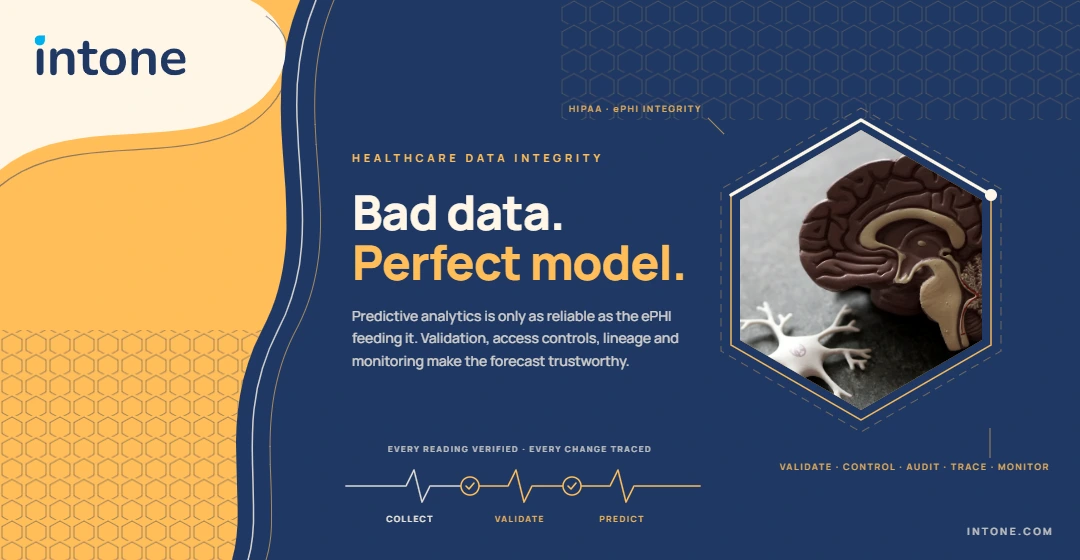
Why data integrity, data validation, and evidence transparency matter for modern healthcare security and reliable analytics.
Healthcare data integrity requires more than standard security controls; it requires appropriate data validation, access controls, audit controls, traceability, and monitoring throughout the data lifecycle. These measures can help healthcare organizations protect electronic health information from unauthorized alteration or destruction while improving visibility into how data moves across connected systems.
What is Healthcare Data Integrity?
Healthcare data integrity is the accuracy, consistency, completeness, and reliability of healthcare data throughout its lifecycle, from collection and storage to use and sharing.
Introduction
Healthcare organizations increasingly rely on digital information for clinical operations, analytics, reporting, administration, and decision-making.
Predictive analytics in healthcare can help organizations identify patterns and support forecasting, but the reliability of any analytical process depends on the quality and integrity of the information used.
When healthcare information is incomplete, inaccurate, corrupted, or improperly modified, the resulting analysis may also be unreliable.
Data integrity has therefore become an important component of healthcare cybersecurity and compliance. The HIPAA Security Rule requires covered entities and business associates to protect the confidentiality, integrity, and availability of electronic protected health information (ePHI), including protection against improper alteration or destruction.
Healthcare organizations therefore need controls that help protect information throughout its lifecycle—from collection and storage to integration, processing, transmission, and use.
As healthcare environments become increasingly connected, this challenge becomes more complex. Electronic health records, laboratory systems, claims platforms, medical devices, patient portals, APIs, databases, and analytics platforms may all exchange information.
Without appropriate validation, access controls, monitoring, and traceability, organizations may struggle to determine whether information remains accurate or whether an unexpected change occurred as data moved between systems.
For organizations looking to strengthen healthcare-specific governance and compliance practices, IntoneCCM’s Healthcare & Life Sciences solutions provide capabilities covering audit, risk, compliance, evidence automation, and centralized oversight.
Understanding Healthcare Data Integrity and Security Hazards
Healthcare data integrity refers to maintaining the accuracy, consistency, completeness, and reliability of health information while protecting it against unauthorized alteration or destruction.
Data-integrity problems can result from:
- Unauthorized modification
- Human error
- Incorrect data entry
- Integration errors
- System failures
- Incomplete information
- Software or configuration issues
- Malicious activity
Healthcare data integrity should not be confused with a conventional data breach.
A breach generally involves unauthorized access to or disclosure of information, whereas a data-integrity issue concerns whether information has been improperly altered, destroyed, corrupted, or otherwise made unreliable.
The two risks can occur together. For example, an unauthorized user who gains access to a healthcare system could potentially modify information during the same security incident.
HHS requires regulated entities to protect ePHI against improper alteration or destruction and to implement appropriate mechanisms for protecting its integrity.
For healthcare organizations, reliable information is essential because inaccurate data can affect downstream reporting, analytics, operational processes, and potentially clinical decision-making.
Organizations can also use data quality management practices to address validation, standardization, monitoring, and governance issues that can affect the reliability of healthcare information.
The Analytics Paradox
Many healthcare organizations invest in automation and predictive analytics expecting these technologies to improve efficiency, reduce manual effort, and support better decision-making.
From an operational perspective, that expectation is reasonable: automated systems can process large amounts of information consistently and reduce repetitive tasks.
However, automating an analytics process does not automatically guarantee that the underlying healthcare data is accurate, complete, or secure.
A predictive model may execute correctly while still producing unreliable results if the information supplied to it is incomplete, inaccurate, incorrectly transformed, or improperly modified.
When confidence in data integrity is missing, healthcare organizations may still need additional reconciliation, validation, and investigation.
This can reduce some of the expected efficiency benefits of healthcare automation.
The result is an analytics paradox: organizations can automate predictive analytics and clinical data processes while still facing challenges in proving that the information supporting those processes is trustworthy.
Examples of Predictive Analytics in Healthcare
Predictive analytics helps healthcare organizations use historical and real-time data to anticipate outcomes, improve decision-making, and allocate resources more effectively.
- Patient readmission prediction: Predictive models can identify patients who are at higher risk of being readmitted after discharge, allowing healthcare providers to plan follow-up care and preventive interventions.
- Resource planning: Hospitals can forecast patient volumes, staffing requirements, bed occupancy, and equipment demand to improve resource allocation and operational efficiency.
- Fraud detection: Predictive analytics can identify unusual billing patterns, suspicious claims, and other anomalies that may indicate healthcare fraud.
- Population health analytics: Healthcare organizations can analyze patient and demographic data to identify health trends, assess risks across populations, and support targeted preventive care.
Implementing Healthcare Data Integrity and Auditing Controls
Ensuring that healthcare information remains accurate and trustworthy is critical to supporting reliable healthcare operations and analytics.
Organizations can implement several practical measures to protect healthcare information against unauthorized access, improper alteration, and data-quality problems:
Implement Data Validation Checks
Data validation checks can help identify errors and inconsistencies before information moves into downstream systems.
These checks can include:
- Verifying formats
- Checking acceptable values and ranges
- Identifying missing information
- Identifying duplicate records
- Validating required fields
- Checking relationships between data elements
For healthcare organizations, validation can help improve the reliability of information used for reporting, analytics, claims processing, and other operational activities.
IntoneCCM’s healthcare data quality management guidance also highlights validation, standardization, monitoring, and data governance as important components of maintaining reliable healthcare data.
Monitor Data Sources
Monitoring healthcare data sources can help organizations identify inconsistencies or unexpected changes during collection and processing.
This may include monitoring information from:
- Electronic health records
- Laboratory systems
- Claims platforms
- Medical devices
- APIs
- Databases
- Analytics platforms
Implement Access Controls
Access controls help restrict access to healthcare information to authorized individuals and systems.
Organizations can use appropriate permissions, roles, authentication mechanisms, and access reviews to reduce the risk of unauthorized access or modification.
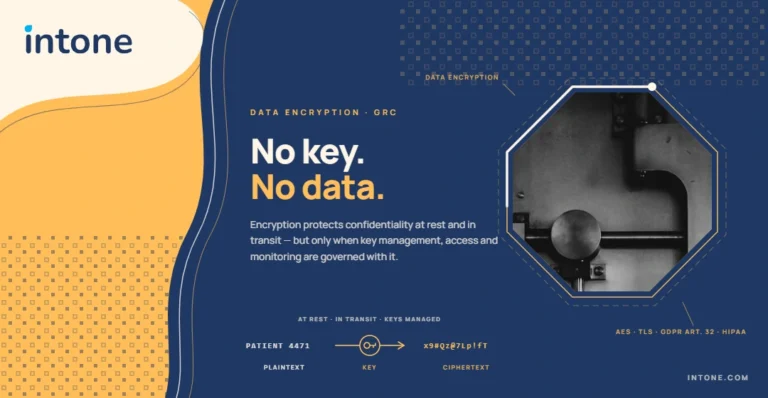
Use Data Encryption
Encryption can help protect sensitive healthcare information from unauthorized access while it is stored or transmitted.
However, encryption should not be treated as a standalone data-integrity solution. Organizations also need appropriate validation, access controls, audit controls, and monitoring.
Audit Healthcare Data
Audit controls can help organizations record and examine activity involving systems that contain or use ePHI.
Reviewing relevant access and change information can support security investigations and help organizations identify potentially inappropriate activity.
Establishing consistent controls across healthcare systems can improve visibility and reduce inconsistencies in how security and data-quality requirements are implemented.
For healthcare organizations seeking broader compliance and audit capabilities, IntoneCCM’s Healthcare & Life Sciences solutions include audit and compliance capabilities designed for healthcare environments.
Aligning Controls Across Healthcare Units to Protect Data Integrity
A major challenge in healthcare security architecture is inconsistent control execution across different departments and systems.
For example, one department may use strong validation and access controls while another relies heavily on manual processes.
These differences can create gaps in the organization’s overall control environment.
Establishing common security principles across healthcare units can help ensure that systems, APIs, databases, and integration processes follow appropriate validation and security requirements.
Organizations can align their security practices with established frameworks such as the NIST Cybersecurity Framework (CSF) 2.0 and ISO/IEC 27001.
NIST CSF 2.0 provides organizations with a structured approach for managing and communicating cybersecurity risk.
However, healthcare organizations should not assume that every system requires identical controls. Security measures should be appropriate to the organization’s risks, technology environment, and regulatory requirements.
Streamlining Automated Evidence Collection and Reducing Manual PBC Requests
Healthcare compliance and audit processes can require teams to collect information from multiple systems.
This may include:
- Access records
- Audit logs
- System reports
- Configuration information
- Data-quality reports
- Testing documentation
- Other supporting evidence
When this information is collected manually, audit preparation can become time-consuming and difficult to manage.
Automated evidence collection can retrieve relevant information from underlying systems and reduce repetitive manual work.
This can help organizations:
- Improve consistency
- Reduce manual effort
- Increase visibility
- Support audit preparation
- Minimize disruption to operational teams
However, automated evidence collection should not automatically be described as “tamper-proof” or “more reliable” without evidence.
Organizations still need appropriate controls over the underlying systems, collection mechanisms, timestamps, access, and evidence storage.
IntoneCCM’s Healthcare & Life Sciences solutions include evidence automation and are positioned to support faster audit readiness and centralized compliance visibility.
Leveraging intoneSwift® to Strengthen Healthcare Data Integration
Healthcare organizations increasingly need to connect information across EHRs, databases, applications, APIs, analytics platforms, and other systems.
Reducing data-quality and integration risks requires organizations to improve visibility into how information moves between these environments.
intoneSwift® a data integration and management solution designed to help organizations integrate information across diverse systems.
Its published capabilities include:
Knowledge Graph Generation
Generates knowledge graphs across data integrations, helping organizations visualize relationships between connected information sources.
Extensive Connectivity
Intone states that IntoneSwift provides 600+ data, application, and device connectors, helping organizations connect diverse information sources.
Low-Code Interface
Provides a graphical low-code/no-code environment designed to simplify configuration and management of data integrations.
High-Speed Execution
Intone describes distributed in-memory data operations for high-speed processing. Any specific performance figure should be presented as an Intone-published claim rather than as an independently verified benchmark.
Attribute-Level Lineage
Tracks individual attributes through integration processes, providing greater visibility into where information comes from, how it changes, and where it goes.
For additional context, IntoneCCM’s article on data lineage explains how tracing data through its lifecycle can help organizations understand changes resulting from migrations, system updates, and other processes.
Comprehensive Encryption
Supports encryption of sensitive information across different processing stages, helping reduce the risk of unauthorized access.
Centralized Credentials
Centralizes password and connection management across integrated systems.
Versatile Processing
Supports real-time, streaming, and batch processing approaches according to operational requirements.
Heterogeneous Support
Supports different combinations of information sources, helping organizations integrate information across complex technology environments.
Real-Time Monitoring
Provides real-time visibility into integration activities, helping teams identify issues and respond more quickly.
Integrating IntoneSwift into a healthcare technology environment can help organizations manage diverse data streams while improving visibility, traceability, and integration management.
However, IntoneSwift should be positioned as a technology that supports healthcare data integration and management, rather than as a solution that independently guarantees HIPAA compliance, prevents every data-integrity incident, or guarantees patient outcomes.
Healthcare Data Integrity Checklist
Healthcare organizations can use this checklist to maintain accurate, consistent, and reliable data:
- Validate data accuracy: Regularly check patient and operational data for errors or inconsistencies.
- Maintain data completeness: Ensure required information is captured and updated throughout the data lifecycle.
- Apply access controls: Restrict sensitive healthcare data to authorized users.
- Monitor data changes: Track modifications to maintain clear audit trails and accountability.
- Standardize data: Use consistent formats, definitions, and data-entry practices across systems.
- Conduct regular audits: Review data quality and integrity controls to identify and address issues promptly.
Key Takeaways
- Validate healthcare information: Use validation checks to identify inconsistencies before they affect downstream systems and analytics.
- Standardize security controls: Apply appropriate and consistent access, validation, and monitoring practices across healthcare systems.
- Maintain data lineage: Track how healthcare information moves and changes across connected systems.
- Automate evidence collection: Reduce repetitive manual audit preparation where appropriate.
- Use continuous monitoring: Improve visibility into data and integration activity and investigate potential issues earlier.
FAQ’s
Data integrity helps ensure that healthcare information remains accurate and is not improperly altered or destroyed. Reliable information is important because analytics and operational decisions depend on the quality of the underlying data.
A data breach generally involves unauthorized access to or disclosure of information. Data manipulation involves improper alteration, destruction, or corruption of information. A single security incident can involve both risks.
Data lineage provides visibility into where information originates, how it moves through connected systems, and what transformations occur. This can improve traceability and support troubleshooting and data-quality management.
Standardized security principles help organizations apply appropriate validation, access, monitoring, and governance practices consistently across different healthcare systems and departments.
Automated evidence collection can reduce repetitive manual work involved in gathering audit and compliance documentation while improving consistency and visibility.
intoneSwift® provides capabilities including attribute-level lineage, encryption, monitoring, flexible processing, centralized connection management, and 600+ connectors to help organizations integrate diverse information sources while improving visibility and traceability.
Ready to strengthen healthcare data integrity and secure predictive analytics?
Contact Intone to explore how intoneSwift® can help improve data security, compliance, and evidence management.