

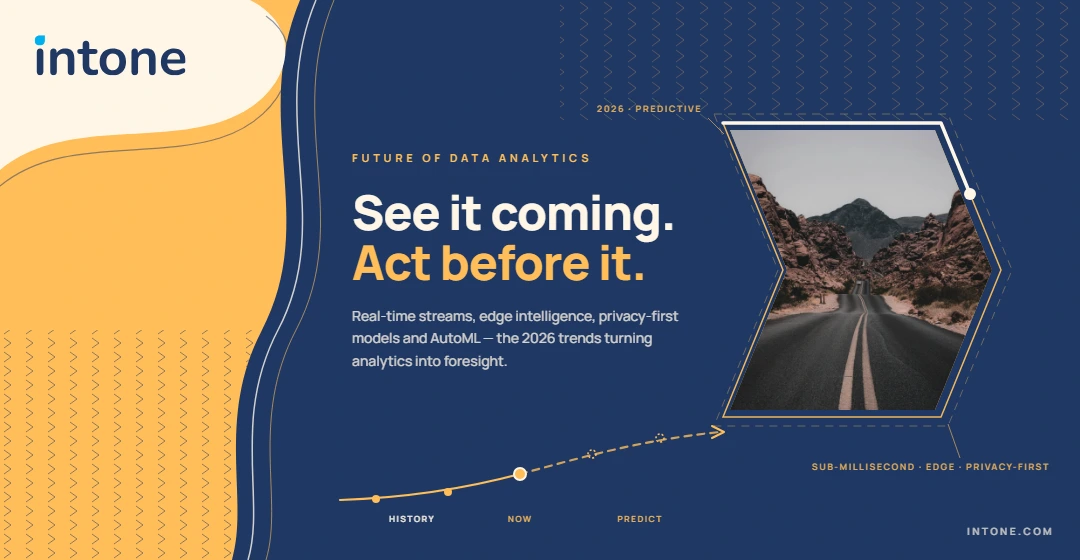
Predictive Analytics Overview: Predictive analytics transforms enterprise decision-making by converting raw digital assets into actionable intelligence through real-time analytics, edge computing, and privacy-enhancing technologies. Integrating advanced machine learning and automated analytics frameworks enables modern organizations to lower operational latency, optimize continuous workflows, and maintain robust regulatory compliance across dynamic enterprise environments.
Key Predictive Analytics Trends for 2026
- Sub-Millisecond Streaming: Shift from batch processing to continuous real-time analytics for instant decisioning.
- Edge Intelligence Migration: Deployment of predictive models directly to IoT hardware and edge nodes to drastically lower latency and bandwidth costs.
- Privacy-Preserving Architectures: Mass adoption of Differential Privacy and Federated Learning for compliant data sharing.
- AutoML & Generative AI Convergence: Democratizing analytics by allowing non-technical business units to build, run, and interpret complex models effortlessly.
Executive Summary & Market Drivers
Data analytics has evolved as an indispensable component of modern strategy, allowing forward-thinking organizations to transform vast volumes of raw digital assets into actionable intelligence. As computational capabilities advance rapidly, the reliance on high-performance data analytics services continues to surge, particularly when evaluating the long-term future of information science and its technological trajectories. These specialized services assist modern enterprises in making confident, evidence-based choices, streamlining complex business operations, and dramatically improving multi-channel customer experiences. By examining the upcoming innovations characterizing 2026 and beyond, corporate leaders can position their infrastructure to gain a sustained competitive edge in an increasingly automated global market.
The strategic necessity of continuous analytics stems from its ability to yield measurable, empirical proof that drives executive strategy. In an era where information is produced at unprecedented velocity, organizations require sophisticated platforms capable of handling high-volume ingestion and low-latency processing. Companies that embrace data-driven operational models consistently report higher productivity, stronger profit margins, and superior agility, making data analytics an absolute operational requirement.
Critical Security & Data Quality Warning: A stark example of operational vulnerability occurred in January 2024 when an Indian internet service provider, Hathway, suffered a major breach exposing the sensitive KYC records of nearly 4 million users due to a vulnerability in its content management platform. Incidents of this magnitude underscore why enterprise security topics, continuous vulnerability assessment, and robust data quality validation must form the cornerstone of any modern analytics framework in 2026.
To explore how holistic computational frameworks solve complex corporate challenges, read the complete overview on the future of data analytics: trends and innovations to watch in 2026.
Recent Innovations and Real-Time Sector Applications
Across global industries, real-time computational applications are fundamentally redefining traditional workflows and creating new efficiency benchmarks. In legal services, top-tier law firms are aggressively deploying generative AI and machine learning to optimize regulatory compliance and contract analysis. For example, McDermott Will & Emery allocated $20 million to The LegalTech Fund to integrate state-of-the-art software solutions into their corporate practice, while DLA Piper leverages advanced analytics platforms to identify potential compliance breaches before they materialize.
| Industry Sector | Primary Technology Deployment | Real-Time Application | Strategic Business Outcome |
| Legal Services | Generative AI & Predictive Models | Pre-emptive breach prediction & legal document automation | Reduced compliance risk and accelerated contract execution |
| Automotive & IoT | 5G Network Integration & Edge Telematics | Over-the-air software updates & vehicle diagnostic monitoring | Enhanced passenger safety, zero-latency navigation, and predictive maintenance |
| Tax & Financial Planning | Customized Enterprise ERP Systems | Real-time tax obligation tracking & continuous transaction auditing | Eliminated manual collection errors and guaranteed continuous compliance |
| Healthcare Services | Streaming Telemetry & Medical Analytics | Continuous patient vital monitoring & predictive clinical alerts | Elevated patient care quality and proactive emergency response |
The automotive sector is similarly undergoing a digital revolution through connected vehicles, high-speed 5G connectivity, and edge computing deployment. At high-profile events like the Wimbledon tennis tournament, connected vehicle initiatives have demonstrated fleets capable of real-time GPS telemetry sharing, dynamic software updates, and continuous vehicle condition monitoring to maximize passenger safety. In tax and financial departments, Deloitte surveys highlight a massive transition toward custom ERP integrations and automated reporting tools to address version control challenges and eliminate manual data aggregation friction.
Navigating the Future: Predictive Analytics, AI Integration, and Streaming Systems
The demand for instantaneous, real-time analytics and data processing has altered global business operations, shifting leadership focus from historical reporting to forward-looking predictive modeling. In the financial industry, quantitative traders and market analysts rely heavily on sub-millisecond streaming telemetry to navigate rapid market fluctuations, manage portfolio exposure, and execute automated arbitrage. E-commerce platforms leverage real-time behavioral streams to instantly personalize shopping recommendations, dynamically adjust product pricing, and optimize supply chain inventory allocation.
| 1. Ingestion Raw Big Data Telemetry Ingest | 2. Edge & Security Edge Analytics & Privacy Encryption | 3. Intelligence Machine Learning & Predictive Modeling | 4. Action Automated Enterprise Decision-Making |
Artificial intelligence (AI) and automated machine learning (AutoML) represent core engines driving this evolution. AutoML democratizes advanced analytics by enabling non-technical domain experts to construct robust statistical models without writing complex code. Concurrently, generative AI automates complex report generation, translating raw data into coherent narrative summaries. Furthermore, the rapid growth of big data analytics has driven processing away from centralized cloud data centers toward localized edge environments. Edge computing minimizes latency for time-critical autonomous navigation, smart city traffic control, and industrial equipment maintenance while drastically lowering bandwidth expenditures.
Architectural Balancing: Privacy-Enhancing Technologies and Sustainability
As organizations scale their reliance on big data repositories, maintaining strict data privacy compliance while deriving deep practical insights presents an ongoing architectural challenge. Modern privacy-enhancing technologies (PETs)—including differential privacy, homomorphic encryption, and federated learning—allow quantitative teams to analyze sensitive datasets without exposing individual identities or violating global mandates such as GDPR and HIPAA. Achieving this equilibrium ensures that enterprises harness the full predictive power of their digital assets while maintaining corporate trust and avoiding severe regulatory penalties.
| Strategic Domain | Supporting Analytics Technology | Implementation Focus | Enterprise Value Delivered |
| Data Privacy & Governance | Federated Learning & Homomorphic Encryption | Secure collaborative model training without raw data exposure | Fully compliant analytics across multi-tenant environments |
| Sustainability Analytics | Environmental Carbon Tracking Systems | Continuous resource utilization monitoring & emission audits | Reduced corporate carbon footprint and optimized ESG scoring |
| Clinical Healthcare | Real-Time IoT Telemetry & Edge Nodes | Automated alerting systems for critical physiological shifts | Direct improvements in patient care and clinical throughput |
| Enterprise Strategy | Intone Insights & Predictive AI Engine | Unified big data integration & automated execution flows | Fast, data-driven business decision capabilities |
In parallel, sustainability analytics has emerged as a mandatory operational capability for global corporations committed to Environmental, Social, and Governance (ESG) criteria. Energy providers utilize high-resolution analytics to balance renewable grid inputs dynamically, while global retailers analyze supply chain logistics to minimize waste and reduce overall emissions. By combining robust data quality standards, privacy-preserving machine architectures, and targeted sustainability metrics, enterprise leadership teams can convert raw telemetry into actionable strategies that yield long-term corporate growth.
Key Takeaways
- Real-Time Processing: Low-latency streaming analytics enables instant organizational reaction to changing market conditions across retail, finance, and industrial sectors.
- Edge Analytics Migration: Moving computation closer to IoT hardware sources reduces network latency, minimizes cloud storage expenses, and delivers localized intelligence.
- Privacy-First Analytics: Privacy-enhancing technologies (PETs) like federated learning permit deep statistical modeling while preserving compliance and user trust.
- Automated Intelligence: AutoML and generative AI streamline feature engineering, democratizing predictive modeling across operational business units.
FAQ’s
Traditional batch analytics processes static historical datasets at scheduled intervals, introducing delays between event occurrence and analysis. Real-time data processing ingests, transforms, and analyzes continuous data streams instantly, allowing systems to output immediate insights and trigger automated responses.
PETs—such as homomorphic encryption and differential privacy—allow algorithms to perform calculations on encrypted data or anonymized aggregates. This ensures enterprises extract valuable statistical trends while strictly adhering to global privacy regulations.
Edge computing processes data locally on sensor nodes or gateways rather than transmitting raw telemetry to central servers. This architecture significantly reduces network latency, lowers bandwidth expenses, and keeps critical operations running even during network outages.
Intone Insights provides end-to-end data integration, automated pipeline orchestration, and advanced analytics infrastructure. It enables enterprises to unify disparate data streams, enforce strict data quality controls, and accelerate automated decision-making.
Ready to transform your enterprise data architecture with modern predictive analytics? Discover how Intone’s end-to-end analytics services and automated integration frameworks can help your organization convert raw digital streams into reliable business intelligence.
Are latency delays, privacy barriers,
and fragmented big data streams holding your executive decision-making back in 2026?
Intone Insights unifies real-time streaming telemetry, edge processing, and privacy-enhancing technologies into an automated analytics framework—converting raw enterprise data into predictive, low-latency business intelligence.
Transform your enterprise data architecture with next-generation predictive analytics today.