

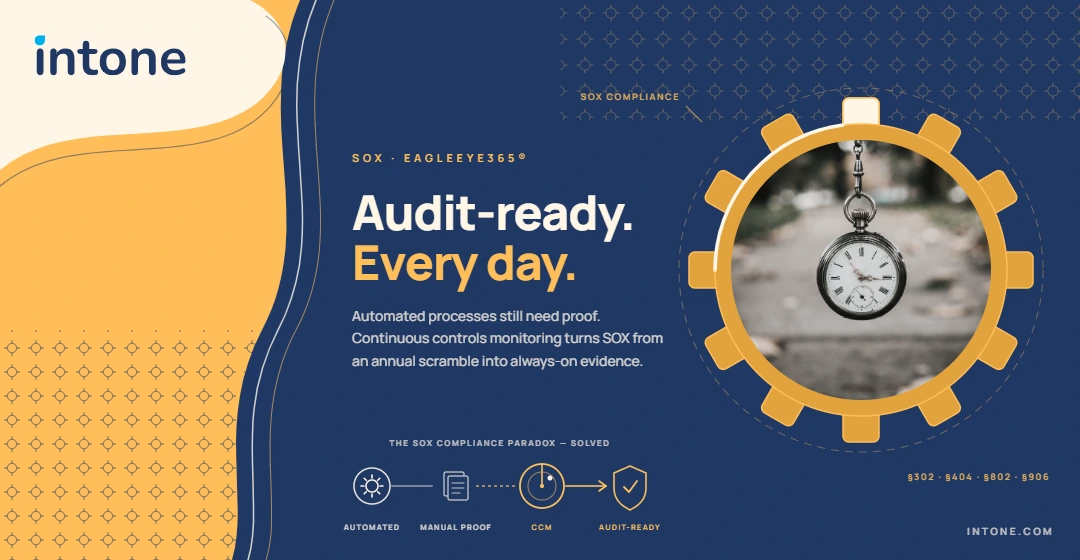
Why internal controls, financial reporting, continuous controls monitoring, and audit readiness matter for modern enterprise governance.
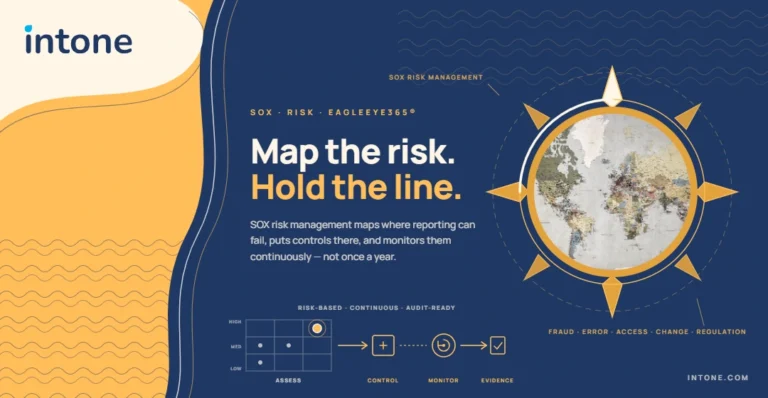
Effective SOX compliance requires more than preparing for an annual audit. Organizations need appropriate internal controls over financial reporting, access controls, change management, control testing, reliable audit evidence, and ongoing monitoring. Continuous controls monitoring and automation can help organizations identify control exceptions earlier, strengthen audit readiness, and improve visibility across complex financial and technology environments.
What is SOX Compliance?
SOX compliance is the process of following the requirements of the Sarbanes-Oxley Act to strengthen financial reporting, internal controls, and corporate accountability.
Introduction
SOX compliance remains an important consideration for companies subject to the requirements of the Sarbanes-Oxley Act of 2002, particularly those responsible for maintaining reliable financial reporting and effective internal controls.
The Act introduced requirements designed to strengthen corporate accountability, financial reporting, auditing, and investor protection. Section 404, for example, requires applicable companies to include management assessment of the effectiveness of internal control over financial reporting in their annual reports. Certain companies are also subject to independent auditor attestation requirements.
For enterprises, however, SOX compliance is not simply about completing paperwork before an audit.
Financial systems are becoming increasingly complex. Organizations may operate across multiple ERP systems, applications, databases, cloud environments, and business units. As these environments expand, finance and compliance teams can face challenges involving access management, control testing, evidence collection, system changes, and remediation.
Organizations therefore need controls that help ensure financial information is accurate, reliable, appropriately protected, and supported by sufficient evidence.
Many organizations have also invested heavily in automation to reduce manual effort and improve operational efficiency. Yet automation alone does not necessarily mean that an organization can easily demonstrate that its controls are working effectively.
This creates an important challenge for modern SOX programs: How can organizations move from periodic, manual compliance activities toward continuous visibility and control monitoring?
Understanding SOX Compliance and Its Key Requirements
SOX compliance involves meeting applicable requirements under the Sarbanes-Oxley Act and maintaining controls that support reliable financial reporting.
SOX is particularly relevant to areas such as:
- Internal control over financial reporting
- Financial reporting processes
- Management certifications
- Access controls
- Segregation of duties
- Change management
- Control testing
- Audit evidence
- Record retention
- Remediation of control deficiencies
The objective is not simply to have controls documented. Organizations need to understand whether relevant controls are appropriately designed, operating effectively, and supported by reliable evidence.
Section 302: Corporate Responsibility for Financial Reports
Section 302 establishes certification requirements for CEOs and CFOs of companies subject to the provision.
The certification addresses matters including review of the report, the absence of materially misleading statements or omissions, and the fair presentation of the company’s financial condition and results of operations in all material respects.
It also addresses disclosure controls and procedures and certain deficiencies and fraud involving management or employees with a significant role in internal controls.
Why it matters: Section 302 reinforces executive accountability for financial reporting and disclosure controls.
Section 404: Management Assessment of Internal Controls
Section 404 focuses on internal control over financial reporting (ICFR).
Applicable companies must include management’s assessment of the effectiveness of their internal control over financial reporting in their annual reports. The SEC’s rules require management to state its responsibility for establishing and maintaining adequate ICFR, identifying the framework used for the assessment, and provide management assessment of effectiveness.
For applicable issuers, an independent registered public accounting firm also provides the required attestation, subject to applicable rules and exemptions.
Why it matters: Organizations need reliable control of documentation, testing, evidence, and remediation processes to support their assessment.
Section 802: Records and Audit Requirements
Section 802 includes provisions concerning certain records and the destruction, alteration, falsification, or concealment of records with the intent to obstruct a federal investigation or certain other proceedings.
It also established requirements concerning the retention of certain audit records.
Why it matters: Organizations need appropriate policies and controls around relevant records and audit documentation.
Section 906: Corporate Responsibility for Financial Reports
Section 906 establishes additional CEO and CFO certification requirements for certain financial reports.
Knowingly, certifying a report that does not meet the statutory requirements can result in significant criminal penalties, with willful violations carrying penalties of up to $5 million and imprisonment of up to 20 years.
Why it matters: Section 906 demonstrates the seriousness of executive accountability for financial reporting.
Understanding SOX Compliance Risks
SOX compliance risks can arise when controls are poorly designed, inconsistently executed, inadequately monitored, or not supported by sufficient evidence.
Common risk areas include:
Unauthorized Access
Employees may have access to financial systems or information that is not appropriate for their responsibilities.
Segregation-of-Duties Conflicts
A user may have combinations of access that allow incompatible financial activities to be performed by the same person.
Uncontrolled System Changes
Changes to applications supporting financial reporting may introduce errors or affect existing controls if they are not appropriately managed.
Inadequate Audit Evidence
Organizations may have difficulty demonstrating that controls operated effectively when evidence is scattered across systems and teams.
Manual Control Testing
Heavy reliance on spreadsheets and manual testing can increase administrative effort and make continuous visibility difficult.
These risks become more challenging as organizations operate across larger and more complex technology environments.
The SOX Compliance Paradox
Many organizations begin automating financial and compliance processes expecting their audit preparation effort to decrease.
From an operational perspective, this makes sense.
Automated processes can:
- Reduce repetitive work
- Improve consistency
- Reduce manual intervention
- Process larger volumes of information
- Support faster identification of exceptions
However, automation alone does not automatically establish SOX compliance.
Auditors and management still need evidence that relevant controls are appropriately designed and operating effectively.
For example, an organization may automate its user-provisioning process. But if the organization does not monitor whether users receive inappropriate access or whether segregation-of-duties conflicts arise, automation has not eliminated the underlying compliance risk.
When control evidence and exception management remain in manual, organizations may still spend significant time preparing audits.
The result is a SOX compliance paradox: enterprises can automate their business processes while still relying heavily on manual compliance activities.
Organizations can explore SOX automation and technology solutions to help reduce manual compliance activities and support more efficient control monitoring.
SOX Compliance Checklist
Use the following checkpoints to strengthen your organization’s SOX compliance and audit readiness:
- Identify key financial controls: Document the controls that directly impact financial reporting.
- Assess financial reporting risks: Identify and evaluate risks that could lead to material misstatements.
- Maintain proper documentation: Keep updated records of policies, procedures, control activities, and evidence.
- Review access controls: Ensure only authorized employees can access financial systems and sensitive data.
- Monitor segregation of duties: Separate critical responsibilities to reduce the risk of fraud and unauthorized activities.
- Test internal controls: Regularly test controls to confirm that they are operating effectively.
- Track control deficiencies: Identify, document, and remediate control weaknesses promptly.
- Maintain audit trails: Ensure financial transactions and control activities can be traced and verified.
- Monitor compliance continuously: Regularly review controls and address changes in business processes or regulations.
- Prepare for audits: Organize supporting documentation and evidence to demonstrate control effectiveness during SOX audits.
Implementing Effective SOX Controls and Audit Readiness Practices
Organizations can strengthen their SOX programs by focusing on several practical areas.
Implement Access Controls
Restrict access to financial systems according to job responsibilities.
Organizations should regularly review user access and investigate inappropriate or excessive privileges.
Enforce Segregation of Duties
Separate incompatible financial responsibilities to reduce the risk of error, fraud, or unauthorized activity.
For example, the ability to create a vendor and approve payments to that vendor may require appropriate separation depending on the organization’s control design.
Strengthen Change Management
Establish procedures to authorize, document, test, and monitor relevant changes to systems that support financial reporting.
Test Internal Controls
Regular control testing helps organizations determine whether relevant controls are operating as intended.
Testing should be supported by appropriate documentation and evidence.
Maintain Reliable Audit Evidence
Organizations should maintain evidence that demonstrates:
- What control was performed
- Who performed it
- When it was performed
- What information was reviewed
- Whether exceptions were identified
- How exceptions were addressed
Monitor Control Deficiencies
When deficiencies are identified, organizations should investigate their cause, assess their significance, document remediation activities, and monitor progress.
Aligning SOX Controls Across Business Units
A major challenge for large enterprises is maintaining consistent control practices across different business units, applications, and locations.
One business unit may have highly automated controls while another may rely heavily on manual procedures.
This inconsistency can make enterprise-wide monitoring more difficult.
Standardizing control definitions, access policies, testing procedures, documentation, and evidence requirements can help organizations establish a more consistent control environment.
Organizations can also align their internal control processes with recognized control frameworks where appropriate.
The SEC’s guidance on Section 404 emphasizes evaluating controls based on the risks to financial reporting and tailoring the evaluation to the organization’s circumstances.
Standardization therefore should not mean applying identical controls everywhere without considering risk. Instead, organizations should establish consistent principles while tailoring controls to the relevant processes and risks.
Streamlining Automated Evidence Collection and Reducing Manual Audit Preparation
Traditional SOX audit preparation can involve significant manual work.
Compliance teams may need to collect:
- Screenshots
- Reports
- Access records
- Transaction samples
- Approval records
- Testing documentation
- System logs
When this information is collected manually from multiple systems, audit preparation can become time-consuming.
Automation can help organizations collect relevant evidence directly from underlying systems and maintain a more organized record of control activity.
This can reduce repetitive administrative work and provide compliance teams with greater visibility into control performance.
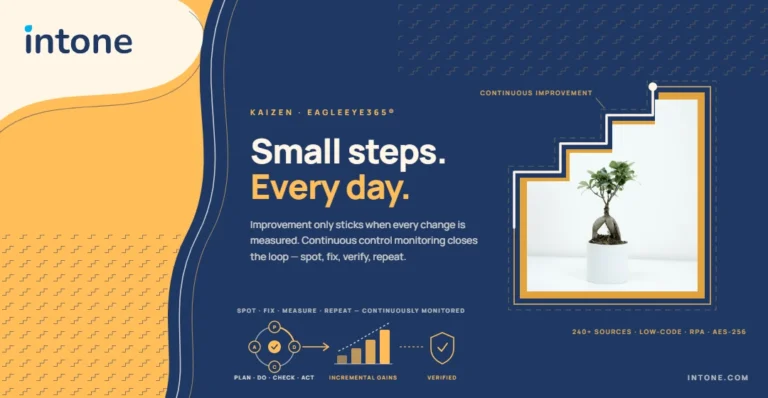
Intone’s GRC monitoring platform, EagleEye365®, is positioned to support continuous controls monitoring, audit evidence generation, exception management, and integration with enterprise systems including SAP, Oracle, Workday, Microsoft Dynamics, and ServiceNow.
Leveraging Intone for SOX Compliance and Continuous Controls Monitoring
SOX compliance becomes more challenging when organizations depend heavily on manual testing, spreadsheets, and periodic reviews.
Intone combines GRC advisory services and continuous controls monitoring to help organizations strengthen their SOX programs.
Intone’s GRC advisory services include SOX readiness/refresh, control rationalization, documentation standardization, IPE validation, segregation-of-duties assessment, remediation frameworks, and policy and control alignment.
Its EagleEye365® platform supports continuous controls monitoring and is designed to provide ongoing visibility into control performance and exceptions.
Continuous Controls Monitoring
EagleEye365® can support continuous monitoring of relevant controls rather than relying entirely on periodic reviews.
Control Deficiency Detection
Organizations can identify and report potential control deficiencies for investigation and remediation.
Access and Segregation-of-Duties Monitoring
Intone’s access-control monitoring capabilities support monitoring of user access, role changes, and potential segregation-of-duties conflicts.
Audit Evidence
Continuous monitoring can support ongoing evidence generation and reduce the need for repeated manual evidence collection.
Enterprise Integration
EagleEye365® supports integration with major enterprise platforms, including SAP, Oracle, Workday, Microsoft Dynamics, and ServiceNow. combining advisory support with continuous monitoring technology, organizations can move toward a more proactive approach to SOX compliance.
SOX Compliance at a Glance
- Purpose: Strengthens financial reporting accuracy and corporate accountability.
- Key focus: Establishes and maintains effective internal controls over financial reporting.
- Who must comply: Primarily U.S. publicly traded companies and certain foreign companies listed on U.S. exchanges.
- Management responsibility: Requires management to assess and report on the effectiveness of internal controls.
- Audit requirements: Requires independent assessments of certain internal controls and financial reporting processes.
- Ongoing monitoring: Organizations should regularly test controls, document evidence, and address control deficiencies.
Key Takeaways
- Strengthen Internal Controls: Establish appropriate controls around financial reporting, access, changes, and other relevant processes.
- Monitor Continuously: Use continuous control monitoring to identify potential exceptions earlier.
- Standardize Control Practices: Apply consistent control principles across business units while tailoring controls to relevant risks.
- Automate Evidence Collection: Reduce repetitive manual work by collecting relevant evidence from underlying systems.
- Monitor Access and SoD: Identify inappropriate access and potential segregation-of-duties conflicts.
- Maintain Audit Readiness: Treat audit readiness as an ongoing process rather than an activity that begins immediately before an audit.
- Remediate Control Deficiencies: Investigate issues, address root causes, and monitor remediation progress.
Contact Us
Ready to strengthen your SOX compliance program and move beyond manual control testing?
Intone can help organizations assess their SOX readiness, strengthen internal controls, monitor control activity, automate evidence collection, and improve ongoing audit readiness.Talk to an Intone SOX and GRC expert to explore the right approach for your organization.
FAQ’s
SOX compliance refers to meeting applicable requirements established under the Sarbanes-Oxley Act of 2002, including requirements related to corporate accountability, financial reporting, internal controls, and auditing.
SOX compliance helps organizations strengthen controls supporting financial reporting, improve accountability, and identify weaknesses that could affect the reliability of financial information.
Section 404 requires applicable companies to include management’s assessment of the effectiveness of internal control over financial reporting in their annual reports. Certain companies are also subject to independent auditor attestation requirements.
Continuous controls monitoring can provide more frequent visibility into control performance, access activity, and exceptions. This can help organizations identify and investigate potential issues earlier instead of relying solely on periodic reviews.
No. Continuous monitoring supports an organization’s SOX program and audit readiness, but it does not replace management’s responsibilities, formal assessments, or applicable independent audit requirements.
Automation can reduce repetitive manual activities, support control testing, monitor relevant activities, and help organizations collect and organize audit evidence more efficiently.
Publicly traded companies in the United States, including their management and auditors, generally need to comply with the Sarbanes-Oxley Act (SOX). Certain subsidiaries and foreign companies listed on U.S. exchanges may also be subject to SOX requirements.
Intone provides GRC advisory services including SOX readiness/refresh, control rationalization, documentation standardization, IPE validation, segregation-of-duties assessment, and remediation support. Its EagleEye365® platform provides continuous controls monitoring and audit-evidence capabilities.