

Why do data quality, policy standardization, and data stewardship matter for modern enterprise security and compliance?
Organizations manage growing volumes of information across applications, databases, cloud platforms, and third-party services. At the same time, privacy and security requirements continue to evolve. Without clear governance, organizations can struggle to determine what data they hold, who is responsible for it, who can access it, how long it should be retained, and whether it is being handled appropriately. A structured data governance program helps establish accountability, consistent data-management practices, and controls that support regulatory compliance.
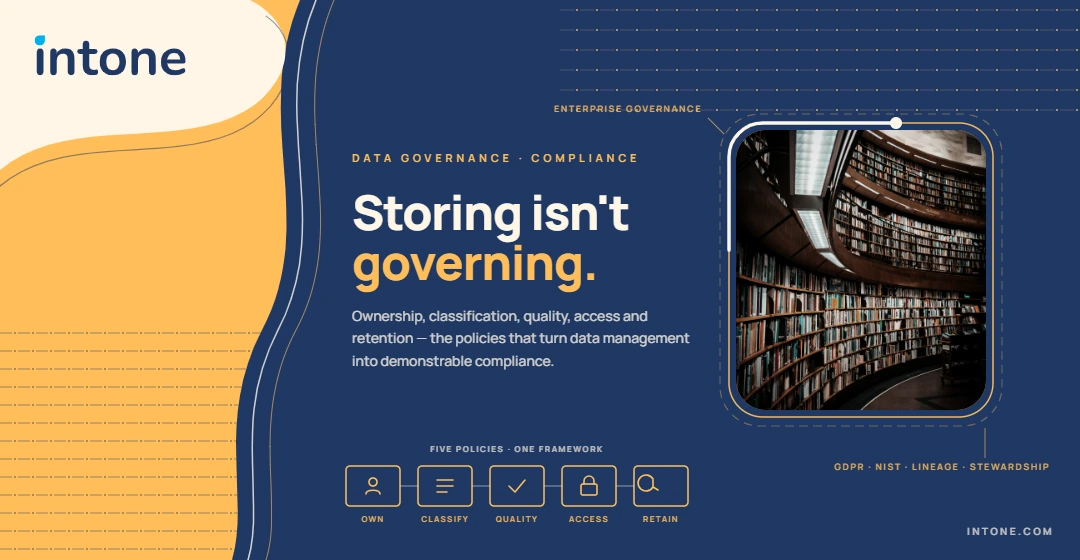
Implementing data governance policies requires more than maintaining data-management procedures. Organizations need clear ownership, data-quality standards, appropriate access controls, classification and retention requirements, and ongoing monitoring. A structured data governance framework helps organizations manage information consistently, improve traceability, protect sensitive data, and demonstrate compliance with applicable requirements.
What Are Data Governance Policies?
Data governance policies are documented rules and guidelines that define how an organization manages, protects, accesses, and uses its data to ensure quality, security, privacy, and compliance.
Introduction
Data governance policies are a critical component of enterprise data management and regulatory compliance. Data governance establishes the authority, responsibilities, processes, and decision-making practices used to manage data assets across an organization.
Poor data management can contribute to privacy, security, quality, retention, and compliance risks. Depending on the applicable laws, regulations, contracts, and industry requirements, organizations may face financial penalties, legal consequences, operational disruption, or loss of stakeholder trust when data is not managed appropriately.Organizations therefore need governance policies that define how information is collected, classified, accessed, shared, retained, monitored, and disposed of throughout its lifecycle.
Organizations have invested heavily in digital transformation and data-management technologies. Yet technology alone does not establish effective governance. IT and compliance teams may still need to demonstrate who owns critical data, whether access is appropriate, whether information is accurate, how long it is retained, and whether controls are operating as intended. A mature governance program combines policy, accountability, processes, and technology.
Understanding Data Governance and Compliance Hazards
Data governance is the formal management of data assets through defined authority, responsibilities, processes, and decision-making practices. Weak governance can leave organizations with unclear ownership, inconsistent access practices, poor data quality, uncontrolled retention, and limited visibility into how information moves across systems.
Poor data governance should not be treated as simply a technology failure or system outage. Governance concerns how data is managed throughout its lifecycle, including its collection, classification, use, sharing, retention, and disposal.
A real-world example is the 2018 Exactis incident, in which security researcher Vinny Troia identified a publicly accessible database containing information associated with approximately 340 million records. Reports described information such as phone numbers, home addresses, email addresses, interests, and other personal attributes. The incident demonstrates the risks associated with exposing large datasets and the importance of appropriate security controls. It should not, however, be presented as proof that a particular data-governance policy would necessarily have prevented the exposure.
Governance gaps can occur during access provisioning, data classification, retention, data sharing, integration, and disposal. Without appropriate policies and controls, errors or unauthorized activities can affect the confidentiality, integrity, availability, and reliability of business information.
Organizations therefore need governance practices that address data throughout its lifecycle. This includes defining ownership, restricting access to sensitive information, establishing retention requirements, maintaining data quality, documenting responsibilities, and monitoring relevant activities.
For enterprises across industries, reliable and appropriately protected data is essential for sound operations and decision-making. Strong governance practices can help organizations improve accountability, reduce avoidable risk, and support compliance with applicable requirements.
For a deeper look at how organizations can implement governance practices, see IntoneCCM’s guide to successful data governance implementation.
Core Components of a Data Governance Framework
A strong data governance framework brings together people, processes, policies, technology, and oversight to ensure data is managed consistently and responsibly.
- People: Define roles and responsibilities for everyone involved in managing and using data.
- Processes: Establish standardized procedures for collecting, managing, accessing, and maintaining data.
- Policies: Create clear rules for data quality, privacy, security, access, and compliance.
- Technology: Use appropriate tools and systems to support data management, security, monitoring, and reporting.
- Data stewardship: Assign data stewards to oversee data quality, consistency, and proper usage within their areas.
- Oversight: Continuously monitor the framework, measure effectiveness, and address governance gaps or risks.
The Governance Paradox
Many organizations expect administrative effort to decline when manual governance and compliance activities are replaced with automated data-management tools. Automation can improve consistency, reduce repetitive work, and provide faster access to information.
However, technology alone does not create compliance. Compliance teams and auditors need evidence that policies are defined, responsibilities are assigned, controls are implemented, and information is being managed according to applicable requirements.
When organizations lack confidence in data quality, ownership, access controls, or retention practices, they may still need extensive manual reviews and reconciliations. This can reduce the efficiency gains expected from technology investments.
The result is a governance paradox: an organization can deploy sophisticated data-management technology while still lacking the policies, accountability, and evidence needed to demonstrate that its data practices are effective.
Implementing Control Standardization and Governance Protocols
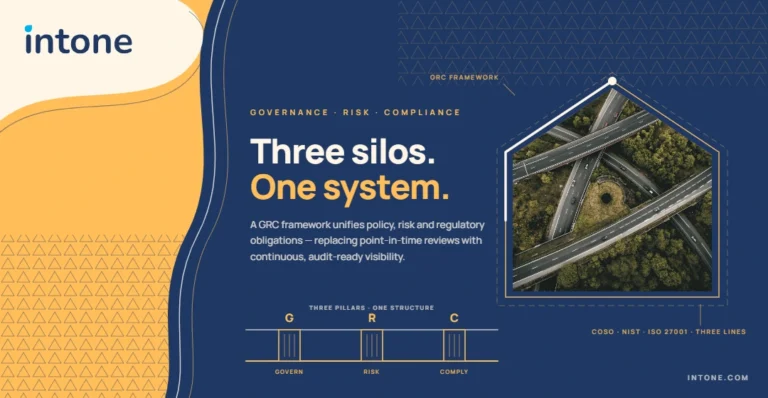
Ensuring that information is managed consistently is essential to data quality, security, and regulatory compliance. Organizations can implement the following governance measures within a broader governance, risk, and compliance (GRC) program:
Data Privacy and Security Policies
Define how personal, confidential, financial, intellectual-property, and other sensitive information should be collected, processed, stored, shared, and protected. Applicable requirements depend on the organization’s activities and jurisdictions. For example, the GDPR establishes principles including lawfulness, purpose limitation, data minimization, accuracy, storage limitation, integrity and confidentiality, and accountability.
Data Quality Policies
Establish standards for accuracy, completeness, consistency, timeliness, validation, issue management, and ownership. Data-quality rules should reflect the business purpose and risk associated with each dataset.
Data Retention and Archiving Policies
Define appropriate retention and disposal requirements for different categories of information. Retention periods should reflect applicable legal, regulatory, contractual, business, and legal-hold requirements rather than applying one period to all data.
Data Access and Usage Policies
Define who may access specific datasets, for what purposes, and under what conditions. Organizations can apply role-based access, least privilege, authentication, periodic access reviews, and segregation of duties where appropriate. Avoid unsupported statistics about the percentage of breaches caused by privileged credentials unless an approved source is available.
Data Classification and Labeling Policies
Classify information according to sensitivity, business criticality, privacy requirements, and applicable regulatory obligations. Classification can help organizations determine appropriate access, protection, retention, and handling requirements.
Establishing standardized governance policies helps organizations apply consistent rules across departments and systems. However, policies are effective only when they are communicated, implemented, monitored, reviewed, and updated. NIST identifies data governance as a set of processes for formally managing data assets across an enterprise, while its Privacy Framework provides a voluntary approach for managing privacy risk. These resources can help organizations structure governance activities but do not themselves create legal compliance.
Aligning Policies Across Business Units for Enterprise Governance
Enterprise data environments often span multiple departments, applications, databases, cloud services, APIs, and third-party providers. When governance practices differ substantially between business units, organizations can develop inconsistent access, retention, classification, and monitoring practices.
Establishing common governance requirements across business units can help organizations apply consistent principles while allowing individual teams to address their specific operational and regulatory needs.
Organizations can establish a cross-functional Data Governance Committee or equivalent governance structure with appropriate representation from business leadership, data management, IT, security, legal, privacy, compliance, and risk functions.
The governance structure can define ownership, approve policies, resolve data-management issues, prioritize improvements, and monitor governance performance.
Organizations should also map applicable regulatory requirements to internal policies and controls. This makes it easier to identify gaps and demonstrate how governance practices support specific compliance obligations.
Streamlining Automated Compliance Monitoring and Risk Auditing
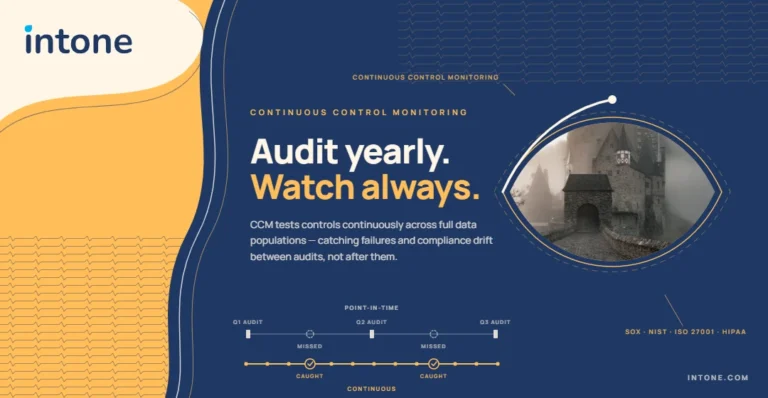
Traditional compliance activities can rely heavily on manual collection of spreadsheets, reports, access lists, system exports, and audit logs. These activities can consume significant time, particularly when information is distributed across many systems.
Automated monitoring and evidence-collection processes can reduce repetitive work and improve consistency by retrieving relevant information directly from connected systems.
Automation should not replace governance oversight. Organizations still need to validate evidence, investigate exceptions, maintain appropriate access to audit information, and ensure that controls remain aligned with applicable requirements.
When implemented appropriately, continuous monitoring can help organizations identify potential control exceptions earlier and move from purely periodic reviews toward a more proactive governance and risk-management approach.
Leveraging IntoneSwift® to Support Data Governance Frameworks
Data governance challenges affect organizations across data-intensive sectors, including healthcare, financial services, marketing, and technology. Managing information across diverse systems requires visibility into data movement, integration, lineage, access, and processing.
IntoneSwift® a data integration solution designed to help organizations connect and manage information across diverse environments. Its capabilities can support the technology layer of a broader data-governance program, including:
Knowledge Graph Generation
Generates knowledge graphs across data integrations to help organizations visualize relationships among connected data sources.
Extensive Connectivity
Supports 600+ data, application, and device connectors, based on Intone’s published product information.
Low-Code/No-Code Interface
Provides a graphical environment designed to simplify configuration and management of data-integration workflows.
High-Speed Execution
Supports distributed in-memory data operations for high-speed processing. Any specific performance multiplier should be presented as an Intone-published claim unless independently benchmarked.
Attribute-Level Lineage
Provides visibility into individual attributes through integration workflows, helping organizations understand data origin, transformations, and destinations.
Data lineage is particularly important for governance because it provides visibility into how information moves and changes. IntoneCCM’s data lineage guide provides additional context on maintaining traceability throughout the data lifecycle
Encryption
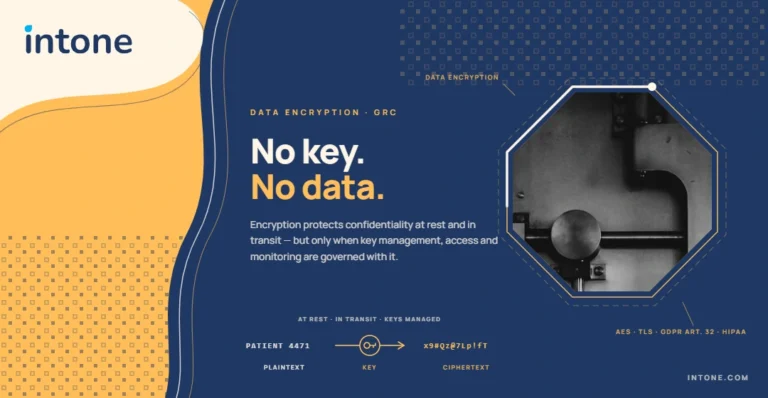
Supports encryption capabilities for protecting sensitive information during relevant processing and integration activities.
Centralized Credentials
Provides centralized capabilities for managing connection and credential information across integrated environments.
Versatile Processing
Supports real-time, streaming, and batch processing for different operational requirements.
Heterogeneous Support
Supports integration across different types of data sources and technology environments.
Real-Time Monitoring
Provides visibility into integration activity to help teams identify issues and respond more quickly.
Integrating intoneSwift® into an enterprise technology environment can help organizations connect diverse data sources, improve lineage visibility, and monitor integration activity. These capabilities can support broader governance objectives, but intoneSwift® should not be represented as independently guaranteeing regulatory compliance. Compliance depends on the organization’s applicable laws and regulations, policies, processes, people, governance structure, and technical controls.
Data Governance Policy Checklist
Use the following action items to strengthen your organization’s data governance policy:
- Define data ownership: Assign clear owners and stewards for critical data assets.
- Establish data classification: Categorize data based on sensitivity, business value, and regulatory requirements.
- Set access rules: Define who can access data and apply appropriate role-based permissions.
- Establish data quality standards: Define requirements for data accuracy, completeness, consistency, and timeliness.
- Define retention requirements: Specify how long different types of data should be retained and when they should be securely deleted.
- Address privacy and compliance: Align data handling practices with applicable privacy and regulatory requirements.
- Document data lineage: Track how critical data is collected, transformed, stored, and shared.
- Review policies regularly: Update governance policies as business needs, technologies, and regulations change.
Key Takeaways
- Inventory and assess data: Catalog important data assets and identify their owners, sensitivity, location, use, and applicable requirements.
- Standardize policies enterprise-wide: Apply consistent privacy, quality, access, classification, retention, and security principles across business units.
- Assign clear ownership and stewardship: Define who is accountable for critical data assets and who is responsible for day-to-day governance activities.
- Maintain data lineage: Track how important information moves, transforms, and is integrated across systems.
- Enforce appropriate access controls: Apply least privilege, role-based access, authentication, and periodic access reviews where appropriate.
- Implement continuous monitoring: Monitor relevant data and integration activities to identify exceptions and support timely investigation.
- Automate appropriate evidence collection: Reduce repetitive manual compliance work while maintaining human oversight and validation.
FAQ’s
Data governance policies are documented rules, standards, responsibilities, and procedures that define how an organization manages its data assets throughout their lifecycle.
Data classification helps organizations distinguish information according to sensitivity, business criticality, privacy requirements, and regulatory obligations so that appropriate controls can be applied.
A data governance policy defines the specific rules and requirements for managing data, while a data governance framework provides the broader structure of people, processes, policies, technology, stewardship, and oversight used to implement and manage data governance.
Access policies define who is authorized to access specific information and under what conditions. Practices such as least privilege, role-based access, authentication, and periodic access reviews can help reduce inappropriate access.
A Data Governance Committee or equivalent governance body can bring together relevant business, IT, security, legal, privacy, compliance, and risk stakeholders to establish policies, assign accountability, resolve governance issues, and monitor progress.
Data lineage helps organizations understand where information originates, how it is transformed, and where it moves. This visibility can support data quality, troubleshooting, impact analysis, governance, and audit activities.
Automated monitoring can reduce repetitive manual reviews, provide more consistent visibility into control activities, and help identify potential exceptions. Human validation and investigation remain important.
intoneSwift® provides capabilities such as extensive connectivity, attribute-level lineage, encryption, flexible processing, centralized credential management, and real-time monitoring that can support data integration and visibility within a broader governance program.
Ready to strengthen your data governance strategy and improve visibility across your enterprise data environment?
Contact Intone to explore how intoneSwift® can help you integrate diverse enterprise data, maintain attribute-level lineage, monitor data flows, and improve traceability across complex systems.